

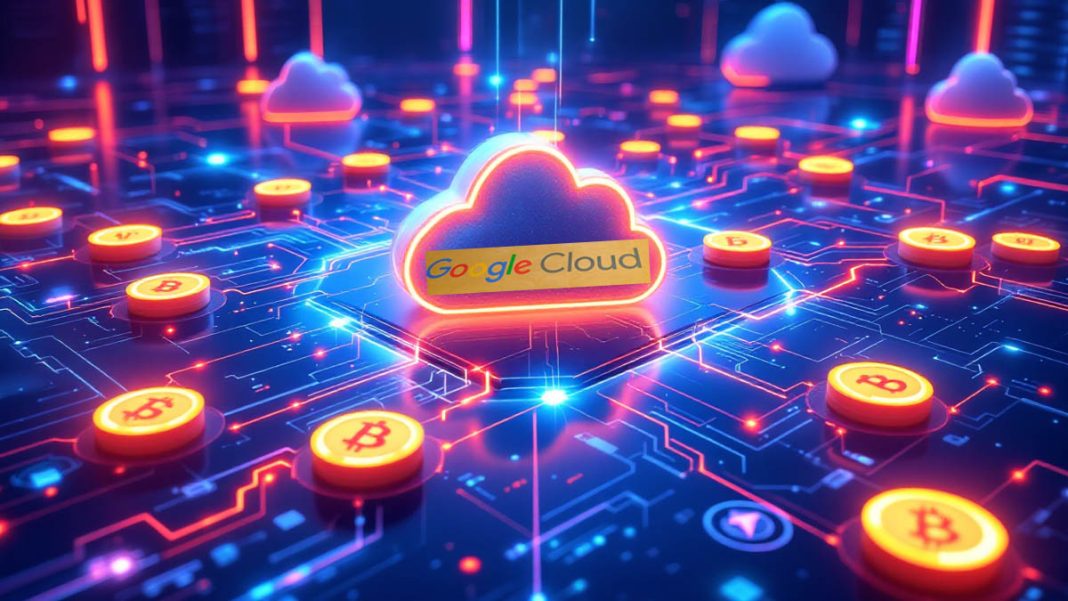
Google Cloud has announced the development of its own blockchain platform, called Google Cloud Universal Ledger (GCUL), designed specifically for the financial sector. The project aims to deliver a unified ledger system that can record transactions, issue digital assets such as bonds, and automate agreements using smart contracts.
According to Rich Widmann, Head of Strategy for Google Cloud Web3, the vision behind GCUL is to provide financial institutions with a high-performance, neutral blockchain platform that supports Python-based smart contracts. Unlike blockchain systems tied to specific ecosystems, GCUL is being positioned as a versatile tool accessible to any financial institution seeking scalable blockchain infrastructure.
Currently, GCUL operates in a closed testnet, with further details expected in the coming months. Google Cloud has described the service as an API-based financial blockchain solution, programmable for payments automation and digital asset management. Importantly, the company emphasizes that GCUL is being built with regulatory compliance in mind, ensuring it functions as a closed and controlled system, rather than an open decentralized network.
Widmann referred to GCUL as a Layer 1 blockchain, but the fact that it is not decentralized has sparked skepticism within the blockchain community. Critics argue that the controlled nature of the platform challenges the very definition of blockchain technology. Despite this, Google insists that neutrality and compliance are key to attracting institutional adoption.
The initiative was first revealed in March 2025 during a collaboration with CME Group, one of the world’s largest derivatives exchanges. Initial trials have already tested settlement and collateral processes, demonstrating the system’s potential for large-scale financial operations. A full launch is planned for 2026, marking a significant step in Google Cloud’s long-term Web3 strategy.
Meanwhile, competitors are also racing to build enterprise-focused blockchain systems. Stripe is developing Tempo, a blockchain integrated with its payment infrastructure, while Circle is advancing Arc, built around its USDC stablecoin. Unlike these, Google claims GCUL will remain ecosystem-agnostic, offering flexibility for global banks, payment providers, and asset managers.
Conclusion: Google Cloud’s Universal Ledger represents a bold step into the enterprise blockchain space, with promises of scalability, compliance, and neutrality. While concerns remain about its lack of decentralization, the platform could reshape how financial institutions issue assets, settle transactions, and automate agreements. With a 2026 launch on the horizon, GCUL may become a cornerstone of the next generation of regulated blockchain solutions for global finance.