


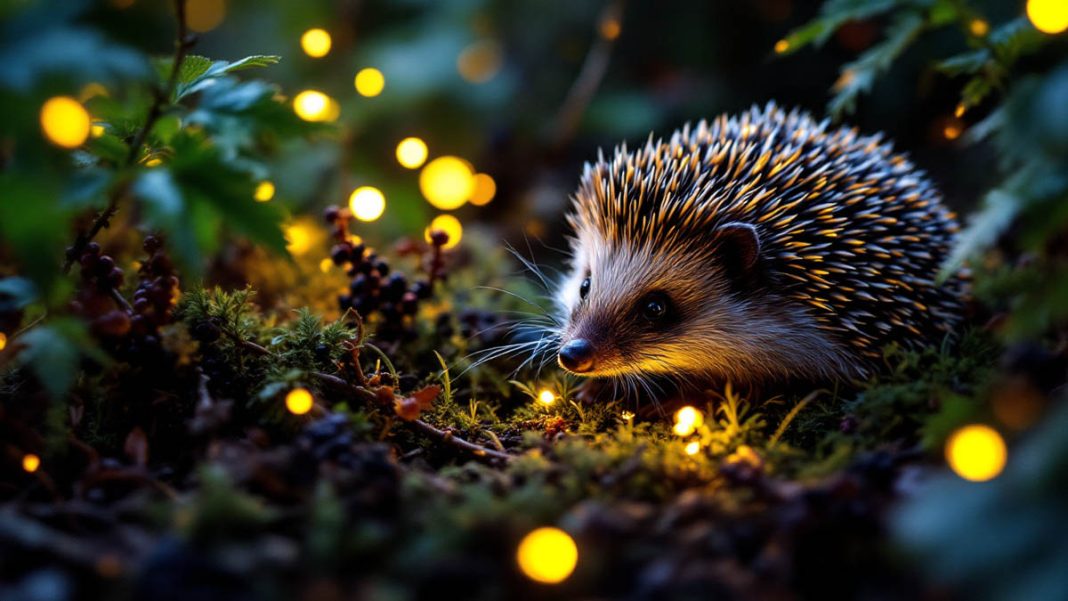
Can artificial intelligence really help us spot hedgehogs from space? Not directly, but according to researchers at the University of Cambridge, identifying bramble patches from satellite imagery could be the next best thing. Since hedgehogs rely heavily on dense vegetation for shelter and foraging, mapping brambles offers a reliable way to predict where these small mammals live.
European hedgehog populations have suffered a 30–50% decline over the past decade, making conservation more urgent than ever. Traditional monitoring methods—such as nighttime field surveys, camera traps, or citizen science reports—are resource-heavy and difficult to scale across national landscapes. The Cambridge team, led by researcher Gabriel Mahler, developed a machine learning model that uses satellite imagery to detect brambles, thereby offering a scalable alternative for habitat mapping.
The AI approach combines TESSERA earth representation embeddings, derived from the European Space Agency’s Sentinel satellites, with data from the iNaturalist citizen science platform. Rather than complex deep learning systems, Mahler’s method uses simpler logistic regression and k-nearest neighbors classification, making it both computationally efficient and accessible. This simplicity could one day allow the model to run directly on mobile devices, enabling real-time field validation.
Early field tests around Cambridge showed promising accuracy. Starting at Milton Community Centre, the researchers quickly confirmed bramble patches where the AI model had predicted them. At Milton Country Park, every high-confidence area turned out to be full of brambles. Even more amusingly, one hotspot flagged by the system led them to Bramblefields Local Nature Reserve, which lived up to its name. However, the model struggled with smaller bramble clusters hidden under tree cover—a natural limitation of satellite-based detection.
While still in the proof-of-concept phase, the implications are significant. By mapping bramble-rich areas at scale, conservationists could better understand and protect hedgehog habitats without needing exhaustive manual surveys. Moreover, the same methodology could extend to other ecological challenges, such as tracking invasive species, monitoring agricultural pests, or mapping biodiversity hotspots.
Conclusion: Although the Cambridge bramble detector is still experimental, it demonstrates how AI-powered satellite analysis can open new doors for wildlife conservation. For species like hedgehogs, whose survival is threatened by urbanization and climate change, scalable habitat mapping may prove essential in reversing population decline. By bridging cutting-edge AI with practical fieldwork, researchers are showing how technology can support—not replace—traditional conservation science.