


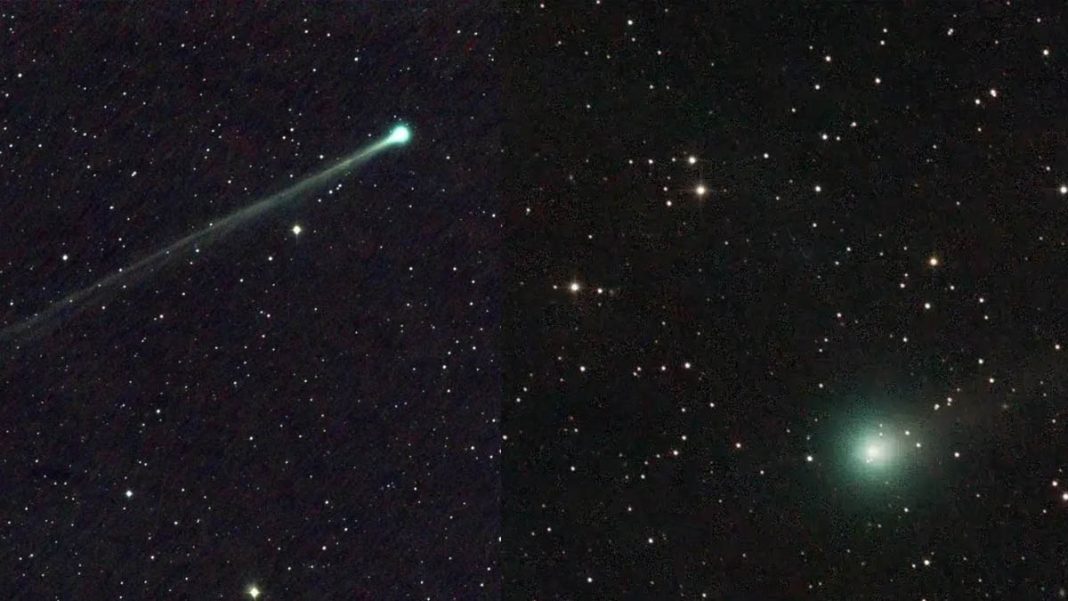
Astronomy enthusiasts and skywatchers are in for a rare astronomical spectacle this October as not one, but two comets will grace the night sky. Both C/2025 A6 (Lemmon) and C/2025 R2 (SWAN) are expected to reach brightness levels that could make them visible to the naked eye under the right conditions, offering an unforgettable cosmic show.
The first comet, C/2025 A6 (Lemmon), discovered on January 3, 2025, has been steadily gaining brightness as it travels deeper into the Solar System. Astronomers estimate that by October 21, its magnitude could reach 3.9, making it visible without a telescope. At its closest approach, the comet will be about 0.6 astronomical units from Earth and best observed shortly after dusk near the stars Arcturus and Izar. To catch it clearly, observers should seek locations with minimal light pollution, as urban areas may obscure its faint glow.
The second comet, C/2025 R2 (SWAN), offers an equally fascinating story. With an orbital period of nearly 22,554 years, its sudden outburst in September surprised astronomers worldwide. The comet was first spotted by Ukrainian amateur astronomer Volodymyr Bezuglyi using images from NASA and ESA’s SOHO spacecraft, equipped with the SWAN (Solar Wind Anisotropies) instrument. Initial observations revealed a magnitude of 7.5, but its brightness is expected to increase significantly by October 21, reaching around 4.0, when it will pass at just 0.27 astronomical units from Earth.
Unlike Lemmon, SWAN will be visible low on the western horizon after sunset, remaining in view for about an hour. Astronomical imaging already shows it has developed a striking gas and dust coma spanning 3.7 arcminutes and an ion tail stretching 2.8 degrees across the sky—five times the apparent diameter of the Moon. Its position near the star Spica in the constellation Virgo will make it easier to locate, especially for observers in the Southern Hemisphere.
The timing couldn’t be better, as October 21 coincides with the New Moon, providing dark skies for optimal viewing. Adding to the spectacle, the annual Orionid meteor shower will peak on October 20–21, with up to 20 meteors per hour, creating a breathtaking convergence of celestial events.
While comets can be unpredictable—sometimes fragmenting or dimming unexpectedly—astronomers believe that both C/2025 A6 (Lemmon) and C/2025 R2 (SWAN) have strong chances of being observed either with the naked eye, binoculars, or a small telescope. For the best experience, observers are advised to plan stargazing sessions between October 20–23, when both comets will be closest to Earth and at their brightest.
In conclusion, the October 2025 night sky promises a spectacular double feature, with two bright comets accompanied by the Orionid meteor shower. Whether you’re an experienced astronomer or a casual skywatcher, this rare cosmic alignment is an opportunity you won’t want to miss.