


NASA has revealed groundbreaking findings that could reshape our understanding of the Red Planet. The Perseverance rover has collected a rock sample from an ancient riverbed in Jezero Crater that may contain potential biosignatures—chemical or structural markers that could indicate past microbial life. The discovery, published in the journal Nature, represents the closest humanity has come to detecting evidence of extraterrestrial life.
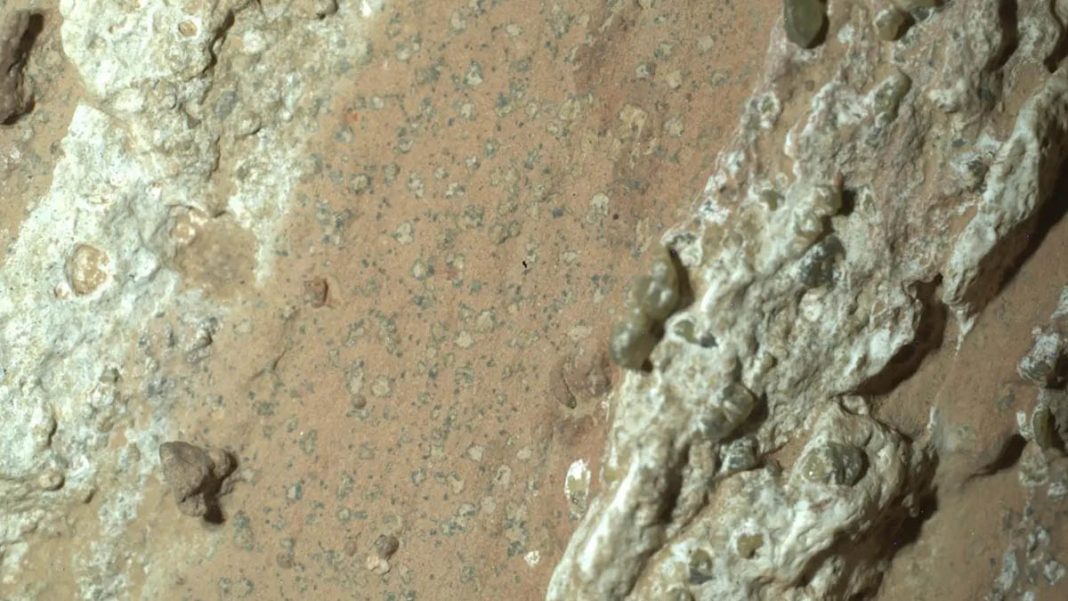
The sample, known as “Sapphire Canyon”, was extracted from a rock called Cheyava Falls in 2024. NASA scientists reported that the rock contains a mixture of organic carbon, sulfur, iron oxides, phosphorus, and clay minerals—compounds that on Earth are excellent at preserving traces of ancient microbial life. More intriguingly, instruments detected unique patterns, nicknamed “leopard spots”, which consist of two iron-rich minerals: vivianite and greigite. On Earth, these minerals are often associated with decaying organic material and microbial activity.
NASA officials emphasized that these findings are not proof of life but strong indicators that warrant further study. A potential biosignature is defined as something that may have a biological origin but requires additional evidence to confirm. “Identifying a potential biosignature on Mars is a revolutionary milestone,” said acting NASA administrator Sean Duffy. He stressed that the agency remains committed to rigorous science as it pushes forward with the ultimate goal of sending astronauts to Mars.
The significance of this discovery lies in the fact that these rocks are among the youngest sedimentary formations studied on Mars. Previous assumptions suggested that evidence of life would be confined to much older formations. However, these findings suggest that Mars may have remained habitable for a longer period than previously thought. If confirmed, this would extend the timeline during which microbial ecosystems could have thrived on the planet.
Key instruments onboard Perseverance, including PIXL (Planetary Instrument for X-ray Lithochemistry) and SHERLOC (Scanning Habitable Environments with Raman & Luminescence for Organics & Chemicals), provided the high-resolution imagery and chemical mapping that identified these potential biosignatures. Researchers observed electron-transfer reactions between organic matter and sediments, processes similar to those used by microorganisms on Earth to generate energy.

While non-biological processes could also explain these mineral formations, the absence of extreme heat or acidic environments in the studied region makes purely chemical explanations less likely. Nevertheless, NASA scientists remain cautious. “Astrobiological claims require extraordinary evidence,” said Katie Stack Morgan, deputy project scientist for Perseverance. The peer-reviewed publication of these results ensures that the data undergoes global scrutiny within the scientific community.
This discovery has energized discussions about whether humanity is truly alone in the universe. Tools like the CoLD framework (Confidence of Life Detection) and rigorous standards of evidence are being applied to analyze these findings. The results may not yet provide a definitive answer, but they mark a critical step forward in astrobiology and planetary science.
Conclusion
NASA’s Perseverance rover has uncovered some of the most compelling evidence yet of possible ancient life on Mars. While the findings require further confirmation, they expand the horizon of where and when life could have existed on the Red Planet. With each discovery, we come closer to answering one of humanity’s oldest questions: Are we alone in the universe?