


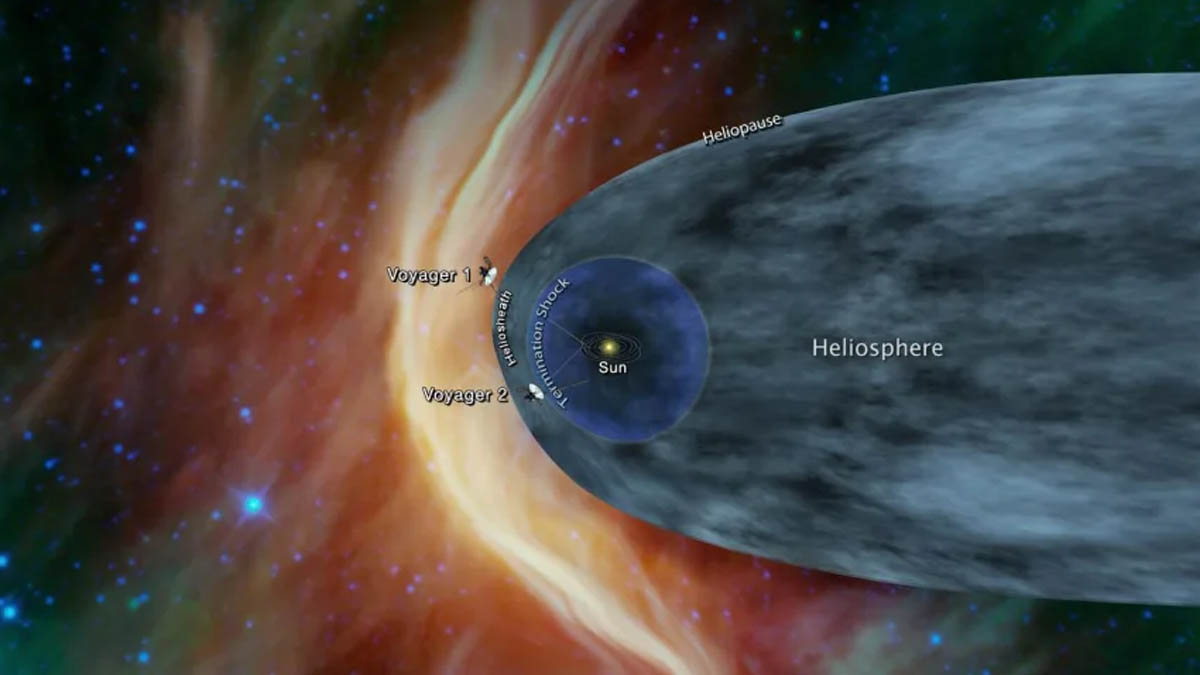
NASA has launched a groundbreaking space mission that could redefine our understanding of the heliosphere — the vast, invisible bubble surrounding our Solar System that shields us from cosmic radiation. Known as IMAP (Interstellar Mapping and Acceleration Probe), this new mission will map and analyze how the solar wind interacts with interstellar space, helping scientists uncover how our Sun forms and maintains this powerful cosmic barrier.
The heliosphere, formed by a continuous stream of charged particles called the solar wind, acts as a natural protective shield for Earth and other planets in the Solar System. It reduces the impact of harmful galactic cosmic rays, which travel from deep space and can pose serious risks to astronauts, satellites, and communication systems. According to NASA, IMAP’s instruments will explore this boundary region located nearly three times farther than Pluto’s orbit, offering insights into one of the most mysterious frontiers of space.
IMAP carries ten scientific instruments designed to capture high-resolution data about charged and neutral particles. These tools will fill critical gaps left by earlier missions like Voyager 1 and 2, which crossed the heliospheric boundary years ago. Unlike its predecessors, IMAP will use 30 times greater imaging resolution to create the most detailed 3D map of the heliosphere ever made. Scientists expect the mission to help predict how solar storms — bursts of radiation and plasma from the Sun — affect Earth’s space weather and technological systems.
Dr. Joe Westlake, Director of NASA’s Heliophysics Division, emphasized the mission’s importance: “Every human and nearly every system on Earth are influenced by space weather. IMAP will provide unprecedented insight into how our Sun’s energy shapes our environment and affects technology critical to modern life.”
Once it reaches its orbit, approximately 1.6 million kilometers from Earth, IMAP will begin real-time monitoring of the solar wind, studying how energetic neutral atoms move across the Solar System. These neutral particles are key to mapping the boundary of the heliosphere, as they travel straight without being affected by magnetic fields. By tracing them back to their sources, IMAP can reveal what happens at the edge of our solar shield — a region that even the Voyager probes could only partially explore.
The IMAP mission launched aboard a SpaceX Falcon 9 rocket from NASA’s Kennedy Space Center in Florida, alongside two other satellites — Carruthers Observatory and NOAA’s SWFO-L1. Together, they form a powerful fleet for monitoring space weather phenomena. The Carruthers Observatory will observe the Earth’s exosphere, capturing ultraviolet light from the outermost atmospheric layer known as the geocorona, while SWFO-L1 will act as an early-warning system for solar storms, sending near real-time data to protect astronauts, satellites, and communication infrastructure.
Dr. David McComas, principal investigator of IMAP and astrophysicist at Princeton University, noted, “IMAP will deliver detailed, time-varying descriptions of the interaction zone between the solar wind and interstellar medium. It will help us understand what this cosmic shield looks like, how it functions, and how it evolves.”
Scientists believe that understanding the heliosphere will not only shed light on the Sun’s influence over Earth’s environment but also offer insights into how other stars form their own astrospheres — protective bubbles similar to our own.
Conclusion:
The IMAP mission represents a significant leap forward in space science and heliophysics, offering the clearest view yet of how our Solar System is protected from the harsh radiation of deep space. As IMAP begins its journey, NASA is poised to unravel the dynamic relationship between our Sun and the galaxy, paving the way for safer space exploration and a deeper understanding of the cosmic shield that makes life on Earth possible.