


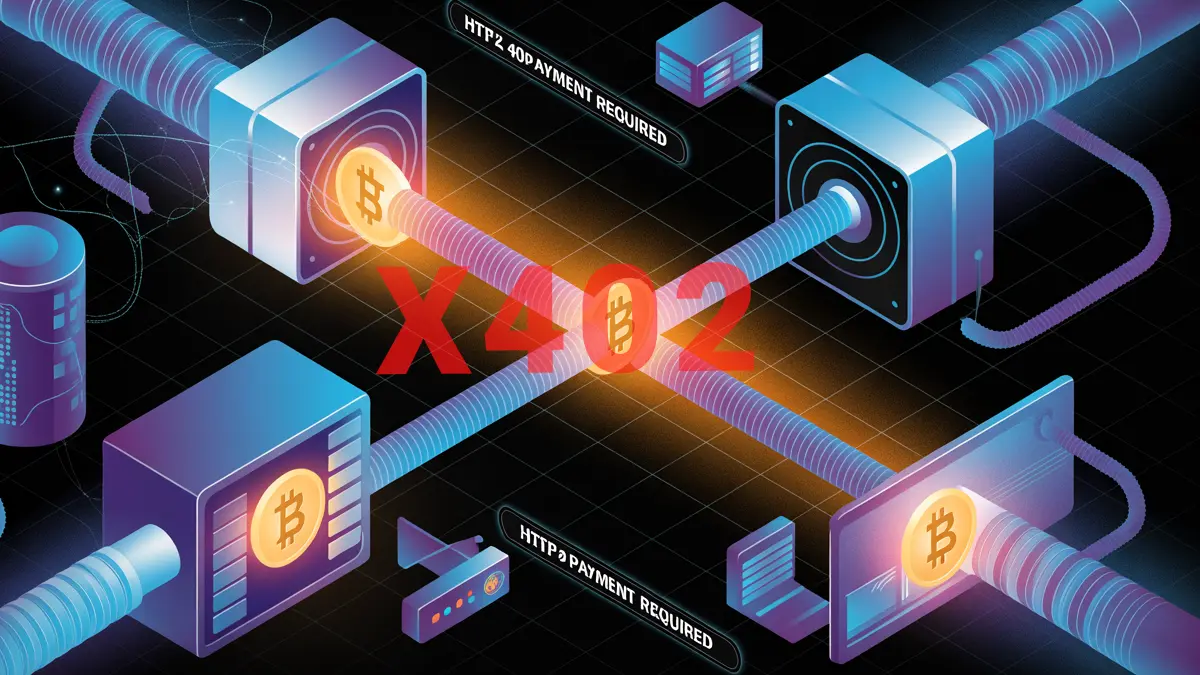
In October 2025, the crypto and tech worlds turned their attention to a bold new idea — x402, a payment protocol jointly developed by Coinbase and Cloudflare. Designed to bring native payments to the Internet, x402 allows websites, AI agents, and apps to embed blockchain-based payment logic directly into HTTP requests. In other words, it makes digital payments as seamless and automatic as sending data online.
The concept behind x402 is both simple and revolutionary. It builds on the long-forgotten HTTP 402 status code — “Payment Required”, which was originally reserved for online payments back in the early 1990s but never implemented. Now, more than three decades later, Coinbase and Cloudflare are breathing new life into it, turning the code into a foundation for the Internet’s next economic layer.
At its core, x402 functions as a communication protocol between clients and servers. When an AI agent, browser, or bot makes a request to a server, the server can respond with a “402 Payment Required” status and a detailed payment description. The client can then complete the transaction using stablecoins like USDC, automatically verify payment, and reattempt the request — all within milliseconds. No user accounts, no credit cards, and no intermediaries.
The protocol is currently optimized for the Base blockchain, where transactions finalize in about 200 milliseconds and cost less than $0.0001. Still, x402 is designed to be multichain, meaning it can operate across different blockchains such as Solana, making it adaptable to future payment ecosystems.
What makes x402 even more appealing is its compatibility with existing EVM standards, particularly EIP-3009, which allows pre-authorized token transfers without the need for separate approval transactions. This design ensures low latency, high throughput, and a near-zero friction experience for developers integrating payments into their systems.
For developers, the setup is surprisingly straightforward. On the server side, an additional middleware layer validates payment receipts. On the client side, SDKs for JavaScript and Python handle payment logic automatically. This means websites, apps, and even AI platforms can now integrate pay-per-use models without complicated billing systems.
Imagine an AI agent paying for API access, data queries, or computing resources in real time. Or a news website charging $0.10 per article view, and a data provider billing $0.005 per API call. These microtransactions, once economically unfeasible with traditional systems, are now possible with x402’s low-cost, high-speed blockchain infrastructure.
The protocol’s backers describe it as the beginning of an “Internet with native payments” — a world where value moves as fast as information. According to Coinbase CEO Brian Armstrong, usage of x402 grew by over 10,000% in October 2025, with nearly 500,000 transactions recorded in a single week.
Experts across the industry see enormous potential. Signum Capital’s investment director Esha Liu called x402 “the HTTPS for value,” while others compare its impact to the early days of TCP/IP — the protocol that made the Internet possible. Developers like 0xCygaar highlight its simplicity for API providers, who can now charge per request without maintaining subscription or invoicing systems.
Beyond the technical promise, x402 also offers a philosophical shift. As developers like Aryan Ebrahimpour from SendAI point out, it could free the Internet from its dependency on advertising. Instead of users paying with their attention and personal data, microtransactions through x402 could let people — or AI agents — pay directly for what they consume, restoring the true economic model of the Web.
Conclusion:
The x402 protocol represents a pivotal evolution in both Web3 and Internet economics. By uniting the reliability of HTTP with the transparency of blockchain, it turns the Internet into a fully transactional network — one where humans, AI, and applications can exchange value seamlessly and securely. As adoption grows, x402 could become the standard that transforms how digital payments work, laying the foundation for a faster, fairer, and more decentralized online economy.