


How Did Earth Get Its Water?
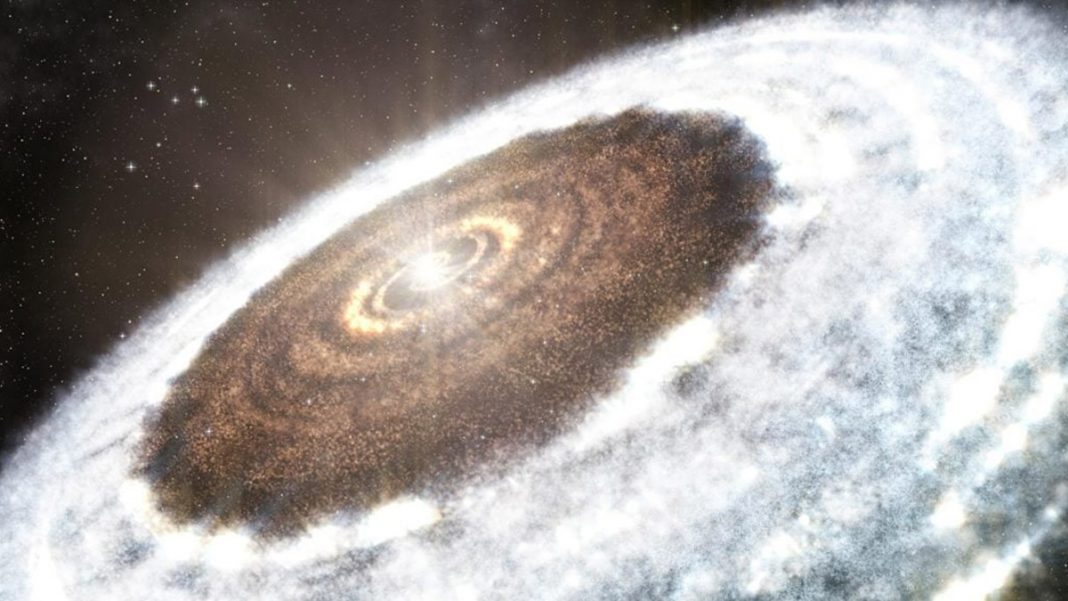
For decades, scientists believed Earth’s water must have arrived from distant regions of the solar system, carried by comets, asteroids, or other icy celestial bodies. This idea, known as the “late veneer” hypothesis, assumes that Earth formed from dry material and was later hydrated by impacts from water-rich objects beyond the so-called “snow line”—a boundary in the protoplanetary disk beyond which ice could form.
But new research is rewriting that theory. Recent findings published in The Astrophysical Journal Letters suggest that Earth may have acquired its water locally, right at the time and place of its formation.
What Is the Snow Line—and Why Does It Matter?
Traditionally, scientists described the snow line as a sharp boundary: on one side, it’s too hot for water to exist as ice; on the other, water can freeze onto dust grains and help form icy bodies. This defined how scientists thought water was distributed across the early solar system.
However, using advances in quantum chemistry, researchers now believe the snow line wasn’t a clean-cut divider. Instead, the energy levels that determine how tightly water binds to dust grains follow a Gaussian distribution. In simpler terms, water didn’t all vanish or appear at one magical distance from the Sun—it could exist in varying amounts across a broad transitional zone, even closer to Earth’s orbit.
Evidence from Dust, Rocks, and Meteors
Lead researcher Lisa Bouatou-Crèpeau and her team argue that tiny ice-coated dust grains could have survived in Earth’s formation zone, gradually clumping into rocks and planets while retaining small but meaningful amounts of water.
Their models align with the water content found in meteorites known as chondrites, particularly the rare enstatite chondrites (EH), which share isotopic similarities with Earth’s water. These rocks serve as time capsules from the early solar system and support the idea that Earth didn’t need cosmic delivery trucks to get wet.
Why This Changes the Narrative
If this new theory holds up, it could explain how Earth maintained enough water to build oceans without disrupting the planet’s growth or relying on a perfectly timed bombardment of comets. It also simplifies the timeline: water wasn’t added after the fact—it was part of the recipe from the start.
Moreover, this model helps answer longstanding questions about how the planet’s interior and surface water cycle might have changed water’s chemical signature over billions of years. These changes could explain why some current measurements differ from theoretical early Earth conditions.
Conclusion: Water May Have Always Been Here
This research doesn’t entirely disprove the late veneer theory, but it does provide compelling support for a local origin of Earth’s water. If future studies continue to reinforce these findings, the narrative of Earth as a dry rock hydrated by passing icy visitors could fade into history.
Instead, we may come to understand our oceans as part of an ancient inheritance, written into the very dust that built our world.