


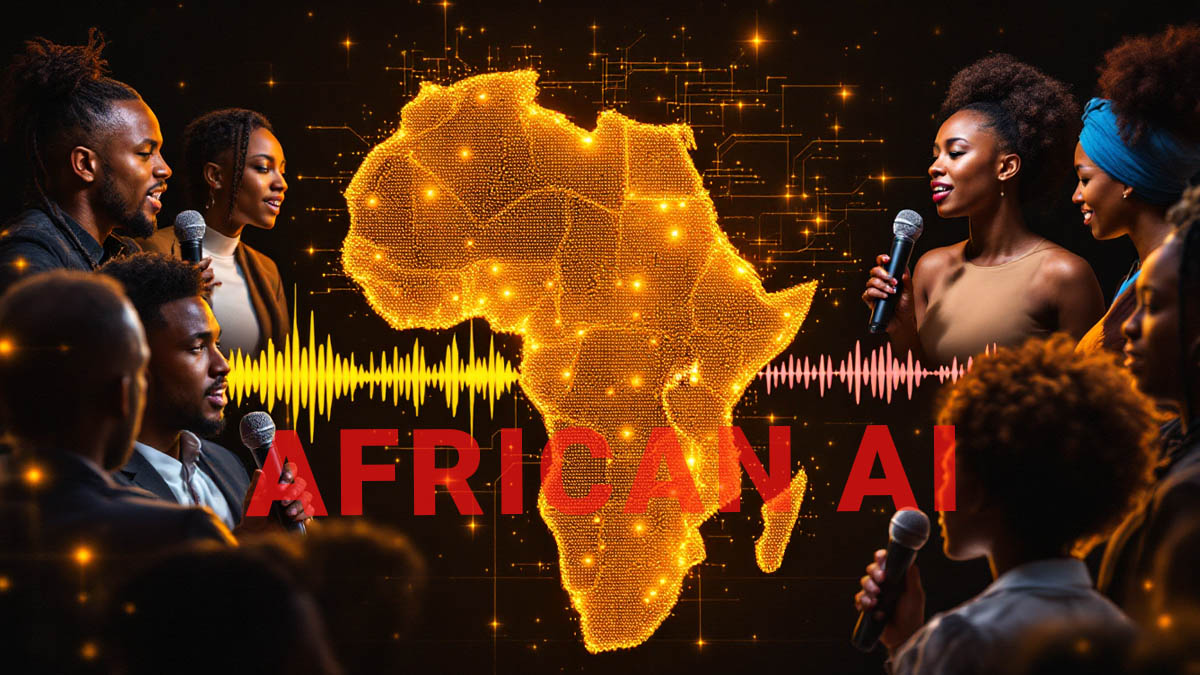
Artificial intelligence (AI) today largely speaks the languages of the Global North — English, Chinese, and a few dominant European tongues. But what happens to the rest of the world when their languages are missing from the data? That’s the critical question driving the African Next Voices Project, a groundbreaking initiative led by African scientists, linguists, and data specialists determined to make AI truly multilingual and inclusive.
Over the past two years, the team has developed what’s believed to be the largest dataset of African languages ever created for AI, spanning Kenya, Nigeria, and South Africa. Their mission is bold yet deeply necessary: to ensure that AI systems understand, process, and communicate in African languages just as effectively as they do in English or Mandarin.
Language, after all, is not just a tool for communication — it’s the core of culture, identity, and thought. Without a shared language, humans and AI can’t truly interact. As AI becomes central to education, healthcare, agriculture, and digital services, systems that fail to recognize local languages risk excluding millions from its benefits. If AI doesn’t speak your language, it doesn’t understand your world.
Why African Languages Are Missing
Centuries of colonial history and modern policy decisions have left African languages digitally invisible. Schools, governments, and media have often privileged colonial languages like English or French, leaving indigenous tongues underrepresented in text and speech data online. The result is an enormous gap in AI training material: no dictionaries, few glossaries, inconsistent spelling systems, missing tone markers, and scarce digital resources.
Without this foundational data, AI models perform poorly — misinterpreting speech, mistranslating phrases, or failing to respond entirely. This exclusion perpetuates the digital divide, depriving millions of Africans of access to AI-driven tools that could deliver healthcare information, improve education, or assist farmers in their native languages.
Inside the African Next Voices Project
To fix this, the African Next Voices Project focuses on Automatic Speech Recognition (ASR) — the technology that converts spoken language into written text. By collecting massive, ethically sourced speech datasets, the project aims to train robust, localized AI models.
In Kenya, through the Maseno Centre for Applied AI, researchers are collecting voice samples in five languages: Dholuo, Maasai, Kalenjin, Somali, and Kikuyu. In Nigeria, Data Science Nigeria is leading efforts to gather data in Yoruba, Hausa, Igbo, Bambara, and Nigerian Pidgin — some of West Africa’s most widely spoken tongues. Meanwhile, in South Africa, the Data Science for Social Impact Lab and partners are recording voices in isiZulu, isiXhosa, Sesotho, Sepedi, Setswana, isiNdebele, and Tshivenda.
Each audio clip is gathered with informed consent, transparent data rights, and fair compensation, reflecting the project’s ethical foundation. Every word is transcribed using language-specific guidelines and technical checks to ensure accuracy.
But the innovation doesn’t stop there. The project collaborates with other pioneering African AI initiatives, including Masakhane, Lelapa AI, and Mozilla Common Voice, forming a vibrant ecosystem of open data, research, and community-led technology development. Together, these networks are turning African languages into a living digital presence, ensuring that no voice is left behind.
Real-World Applications and Impact
The data gathered is already unlocking transformative possibilities. Imagine voice assistants that help farmers in Kikuyu or Yoruba understand weather updates, or call centers that respond to customers in isiZulu or Hausa. AI tools built on African languages can revolutionize service delivery, from healthcare chatbots to educational translators and cultural preservation archives.
As datasets grow, developers will be able to build not only speech models but entire ecosystems — spell-checkers, translation engines, grammar tools, and summarization systems — creating a full digital infrastructure for African languages. The project’s long-term vision is to make it possible for anyone — from a teacher to a small business owner — to use AI naturally in their mother tongue.
The Road Ahead
While the project’s progress is impressive, challenges remain. There are still hundreds of African languages awaiting digital representation. The team is now focusing on integrating these tools into mainstream platforms and ensuring sustainability — from access to computing power to licensing frameworks and open benchmarks.
The next step is interoperability: making sure that speech data connects seamlessly with translation models, grammar checkers, and education tools. Data collection is only the first step — integration is where real transformation begins.
Conclusion:
The African Next Voices Project is more than a dataset; it’s a movement to redefine the future of AI through inclusivity, diversity, and linguistic equity. By empowering AI to understand African languages, the project ensures that the next era of technology doesn’t just speak to Africa but speaks with Africa. In doing so, it’s laying the foundation for a world where AI reflects all human voices — not just the loudest ones.