

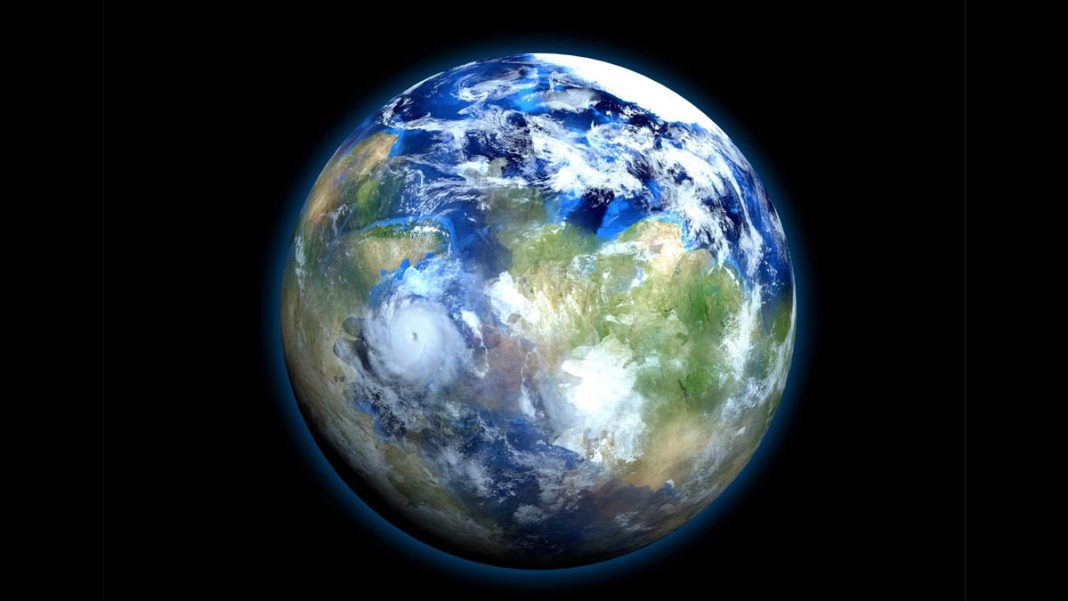
Astronomers using the James Webb Space Telescope (JWST) have made an extraordinary discovery: a rocky planet just 41 light-years from Earth that could potentially host an atmosphere. This planet, known as Trappist-1e, sits in the so-called “habitable zone” of its star, where temperatures may allow liquid water to exist on its surface. If further observations confirm the presence of an atmosphere, Trappist-1e could become one of the most compelling candidates for supporting life beyond our Solar System.
The research, conducted by teams from the University of Bristol and the University of St Andrews, highlights the critical importance of atmospheres for exoplanets. A strong atmosphere is essential not only for retaining heat but also for maintaining surface conditions that allow water to remain stable. Gases within the atmosphere absorb and re-emit radiation, creating a greenhouse effect that helps protect planets from the vacuum of space.
Trappist-1e is one of seven rocky planets orbiting the red dwarf star Trappist-1. Unlike our Sun, Trappist-1 is much cooler, which means its habitable zone is closer to the star. This results in dramatically shorter years—sometimes just a few days—compared to Earth’s 365-day orbit. Interestingly, red dwarfs provide astronomers with unique observational advantages. Because these stars are smaller and dimmer, the transit of a planet across their surface blocks a greater portion of starlight, making atmospheric analysis more feasible.
One of the main methods astronomers use to study these distant worlds is transit spectroscopy. When a planet passes in front of its star, gases in its atmosphere absorb certain wavelengths of light, leaving behind a chemical fingerprint. These signatures reveal what types of gases are present, whether it be water vapor, carbon dioxide, methane, or nitrogen. Such insights can determine whether a planet has the necessary conditions to support life.
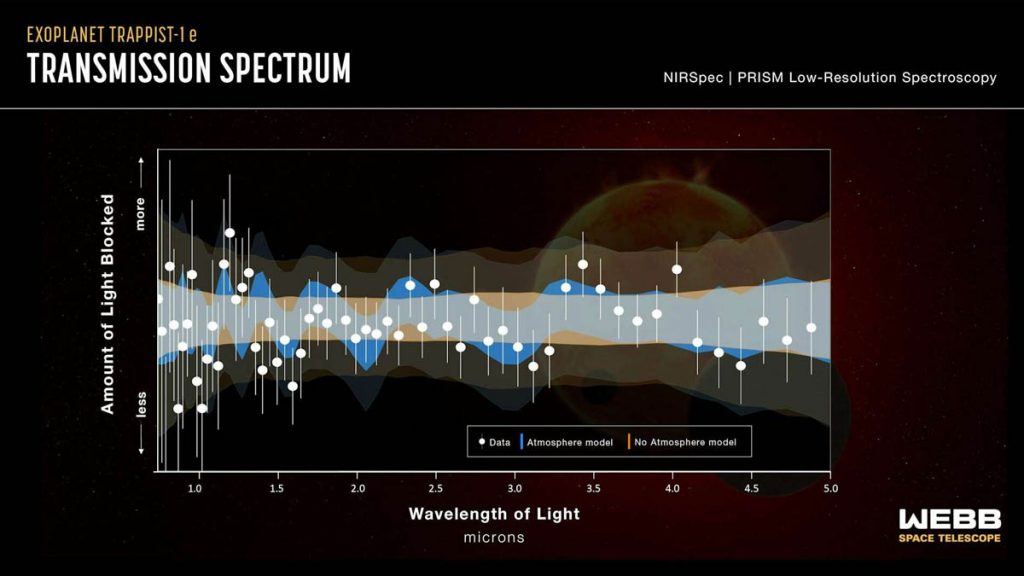
Over the past two years, JWST has focused extensively on the Trappist-1 system, searching for atmospheric signals. Early findings suggest that some of the inner planets are likely barren with thin or nonexistent atmospheres. However, Trappist-1e, located in the optimal habitable zone, remains a prime candidate for hosting a secondary atmosphere rich in heavier molecules. Researchers emphasize that confirming this will require more precise data, as current measurements are complicated by stellar contamination—activity on the red dwarf’s surface that interferes with clean readings.
Astronomers remain cautiously optimistic. Ongoing and future JWST observations, scheduled through 2025, aim to refine data from multiple transits of Trappist-1e and its neighboring planets. By including Trappist-1b—a rocky planet without an atmosphere—in comparative studies, scientists hope to eliminate noise from stellar activity and isolate genuine atmospheric signals.
Conclusion: The discovery of Trappist-1e as a potential Earth twin brings us one step closer to answering one of humanity’s oldest questions: Are we alone in the universe? While it may be too soon to declare this planet habitable, the groundbreaking capabilities of JWST and the unique properties of the Trappist-1 system are pushing us closer than ever before to finding another world with life-sustaining conditions.