


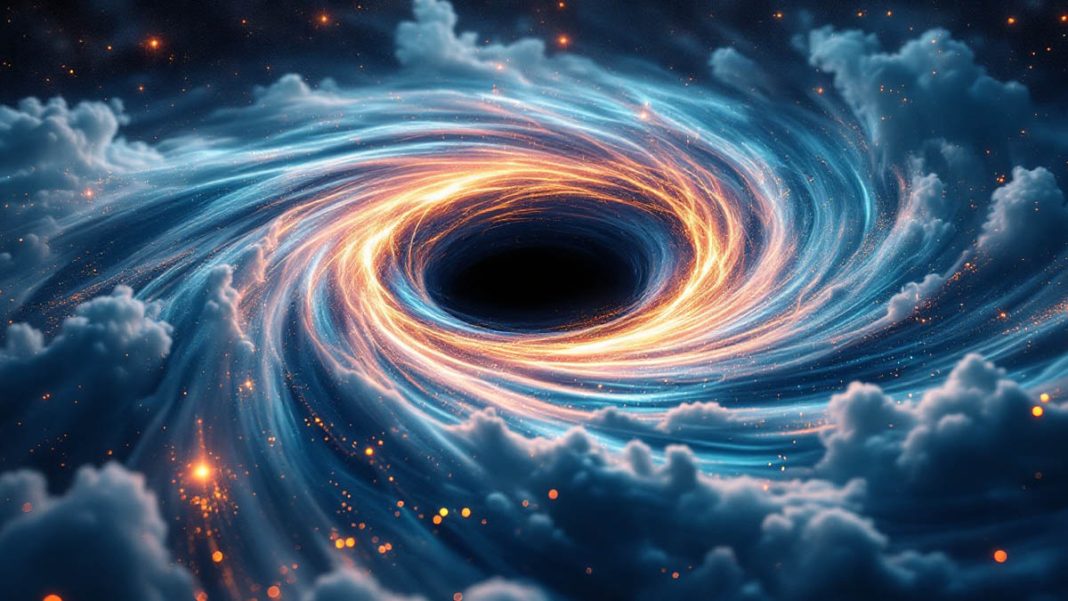
Astronomers may have uncovered a new class of cosmic objects that could change how we understand galaxy formation — Black Hole Stars. These mysterious entities, first hinted at in data from the James Webb Space Telescope (JWST), might explain the puzzling small red dots seen across deep-space images. Recent research suggests that these dots could be supermassive black holes cocooned within vast envelopes of gas, forming an entirely new type of celestial body never observed before.
When JWST began capturing its first high-resolution images in 2022, scientists were stunned by the discovery of tiny, intensely red specks scattered across the early universe. These compact objects emitted light primarily in the mid-infrared spectrum, beyond what the Hubble Space Telescope could detect. Subsequent analysis revealed that their light had traveled over 12 billion years, allowing astronomers to glimpse the universe when it was less than 2 billion years old. Yet their brightness and density didn’t match any known model of galaxies or stars.
Initially, researchers believed these were massive, dust-covered galaxies, densely packed with stars. In such galaxies, a cube of space just one light-year across could contain hundreds of thousands of stars — far beyond what we see even in the densest regions of the Milky Way. However, that explanation quickly ran into problems. The sheer number of stars required to produce the observed brightness was inconsistent with known star-formation rates shortly after the Big Bang.
To test alternative theories, astronomers analyzed the spectral data of one particularly unusual object known as “The Cliff.” Its light took 11.9 billion years to reach us, showing an unexpected feature known as a Balmer break — a sharp rise in ultraviolet wavelengths that didn’t align with any traditional galaxy or active black hole models. After ruling out all conventional explanations, researchers proposed a bold new theory: The Cliff could be a Black Hole Star — or BH* for short.
In this model, a supermassive black hole sits at the core, surrounded by a turbulent, hydrogen-rich gas envelope. Unlike normal stars that shine through nuclear fusion, a BH* glows because the black hole’s intense radiation heats its surrounding gas shell. This setup could explain the reddened light and unusual spectral features JWST observed. What makes this theory particularly exciting is its potential role in rapid black hole growth during the universe’s infancy. Such objects might represent an intermediate stage that allowed early galaxies to evolve faster than previously thought.
Still, questions remain. How do these gas shells remain stable instead of collapsing into the black hole? Could such objects have been common in the early universe, acting as seeds for today’s galaxies? Researchers from the Max Planck Institute for Astronomy (MPIA), led by Anna de Graaff, are now conducting follow-up JWST observations through the RUBIES survey — one of the largest spectral studies of distant galaxies to date — to test whether the Black Hole Star hypothesis holds true.
Conclusion
The discovery of possible Black Hole Stars marks a pivotal moment in modern astrophysics. If confirmed, these enigmatic hybrids could bridge the gap between supermassive black holes and galaxy formation, revealing how the early cosmos built its first colossal structures. For now, they remain an intriguing cosmic mystery, but one that might soon reshape our understanding of how everything we see in the universe began.