


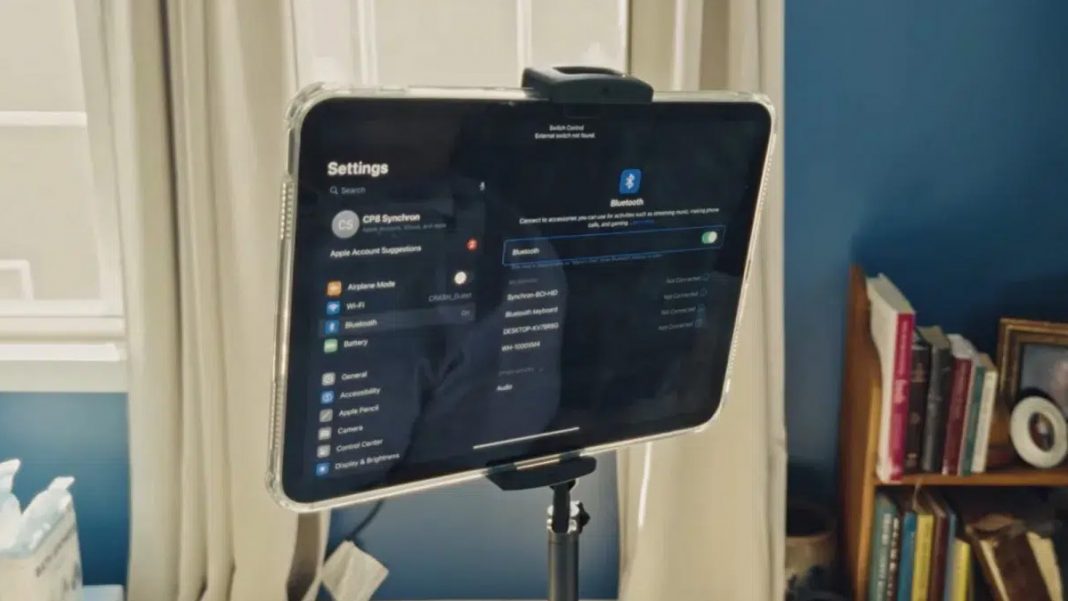
Apple and brain-computer interface (BCI) technology have officially taken a giant leap forward — the tech giant, in partnership with neurotechnology startup Synchron, has demonstrated how iOS gadgets can now be controlled purely by thought. No hands, no voice, not even eye movements — just brain signals.
A Historic First for iPadOS 26
This groundbreaking demo marks the first public example of a brain-computer interface running on iPadOS 26. While Synchron’s system is still far from matching the complexity of Elon Musk’s Neuralink, it’s already showing remarkable potential.
The presentation featured Mark Jackson, a participant living with amyotrophic lateral sclerosis (ALS). Using Synchron’s BCI, Mark was able to open apps, write messages, and control his iPad — all without physically touching the screen.
How the Mind-Control System Works
The system operates through Apple’s new BCI HID protocol, which translates brain signals into device commands — just as if you were tapping the screen or speaking. Even more impressively, it can send feedback from iOS back to the user’s brain or display, helping fine-tune interactions.
At the core of the technology is Stentrode, a tiny implant placed in a blood vessel near the brain’s motor cortex. The procedure is minimally invasive, with surgeons inserting the implant via the jugular vein in the neck — no open brain surgery required. Brain signals are wirelessly transmitted to the iPad, where Switch Control interprets them into usable actions.
Already in Testing — But Not Yet Mainstream
This mind-control capability is now available in iOS 26, iPadOS 26, and select related updates, though it remains in limited trials. According to Synchron, ten patients in the US and Australia have received the implant, all under FDA-approved clinical testing.
Unlike Neuralink, which requires opening the skull to implant thousands of electrodes (up to 4,096 in current versions), Synchron’s approach is safer, faster, and less invasive. This safety factor could make it a frontrunner for wider adoption — but for now, Apple has not made a formal public launch announcement.
The Future of Hands-Free Device Control
With competitors like Neuralink and even gaming visionary Gabe Newell exploring brain-tech integration, the race for everyday mind-controlled devices is heating up. However, Synchron’s low-risk implantation and Apple’s seamless software integration give them a unique advantage.
Conclusion
Apple and Synchron’s BCI breakthrough is more than a technological marvel — it’s a life-changing innovation for people with mobility limitations and a glimpse into the future of hands-free, thought-driven computing. While it’s still in trial phases, the possibility of controlling your iPhone or iPad entirely with your mind is no longer science fiction — it’s here.