


In a groundbreaking leap for intellectual property research, scientists from South Korea and the United States have unveiled an AI-based patent abstract generator that can identify and describe untapped technology opportunities hidden within patent databases. This innovation could completely reshape how startups, corporations, and governments forecast technological trends and design next-generation innovations.
Patents have long served as blueprints of human creativity, providing insight into new inventions and technical progress. However, traditional patent mapping—which uses dimensional reduction to visualize technological clusters—has faced a major limitation: while it highlights “vacancies” or unexplored areas, it fails to explain what technologies could fill those gaps. The result is a map full of empty spaces but no guide to what they mean.
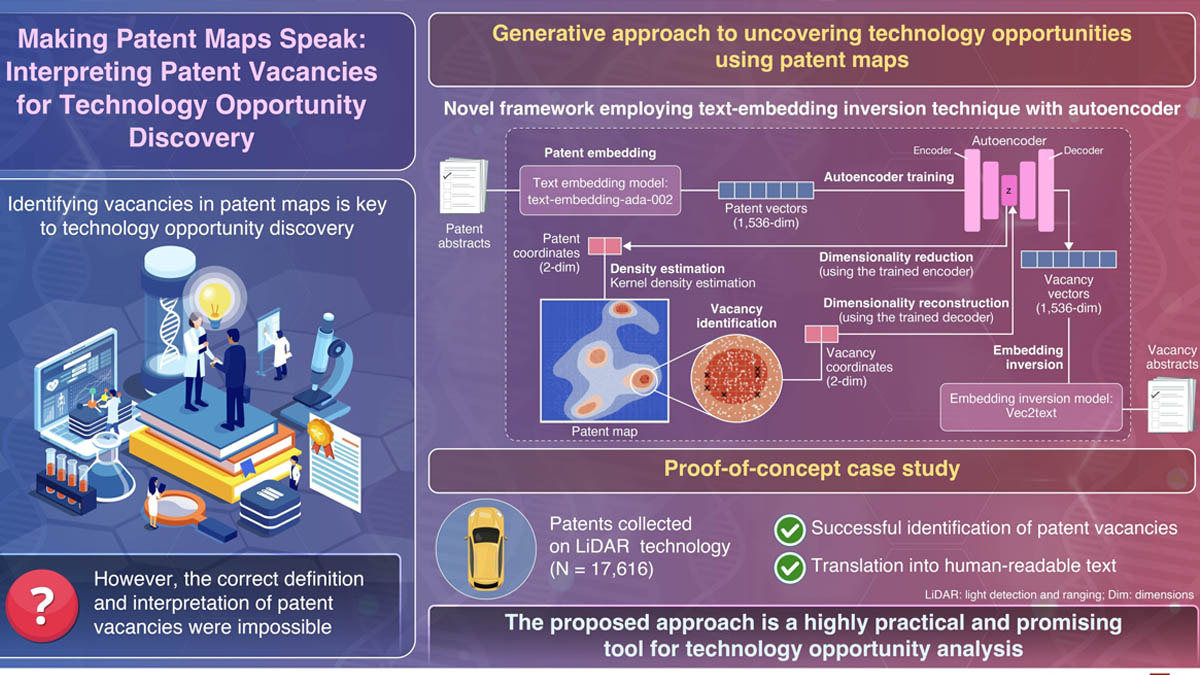
Now, researchers led by Professor Hakyeon Lee of the Department of Industrial Engineering at Seoul National University of Science and Technology have developed an AI-driven method that fills this gap using machine learning and text embedding inversion. Their study, published in Advanced Engineering Informatics, introduces a five-step generative pipeline capable of transforming abstract data into human-readable text describing potential inventions.
The system begins by converting patent abstracts into high-dimensional text vectors, training an autoencoder to project them into a two-dimensional space for visualization. Using kernel density estimation, it identifies low-density “vacant” zones on the patent map—potential innovation areas. The AI then reconstructs these coordinates into detailed, human-readable technology descriptions through a decoding process powered by the vec2text model.
Prof. Lee explains, “The revolutionary aspect of our research lies in its ability to translate patent vacancies into tangible technology descriptions. Previous models could show where opportunities existed, but not what they represented. Now, our AI can pinpoint an unexplored spot on a patent map and instantly generate an abstract detailing the kind of invention that belongs there. It’s like having a treasure map that not only marks the spot but also tells you what the treasure is.”
To validate their approach, the researchers applied the system to LiDAR technology, analyzing over 17,600 patents. The AI successfully identified hidden innovation gaps and generated meaningful patent abstracts, demonstrating its power as a technology opportunity discovery tool.
This breakthrough could transform innovation forecasting. Traditionally, only large corporations with massive R&D budgets could analyze technological landscapes at this scale. Prof. Lee believes this system could democratize innovation, allowing small startups to compete with tech giants, developing nations to leapfrog into advanced sectors, and researchers to discover interdisciplinary projects automatically. It could even help policymakers anticipate technological disruptions before they occur.
In the near future, the team aims to evolve the system into a fully automated AI innovation pipeline, capable of generating entire research proposals and patent drafts from identified opportunities. By shortening the time between idea discovery and product development, this tool could usher in a new era of accelerated, inclusive, and data-driven innovation.