


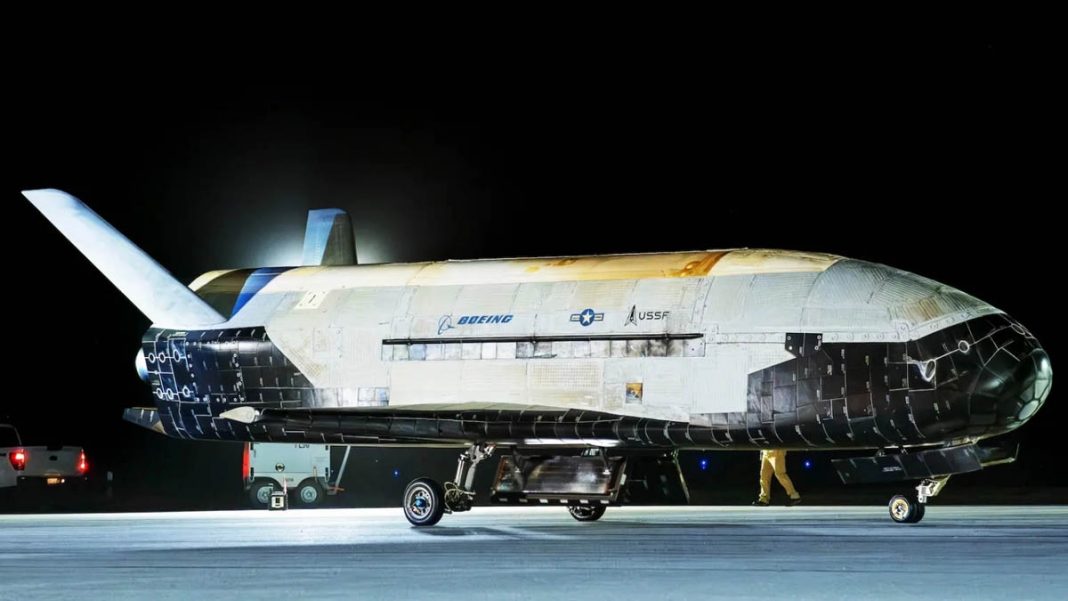
A Secret Mission with a Groundbreaking Goal
The U.S. Space Force’s secret spaceplane X-37B is set to embark on its eighth mission on August 21, 2025, with one groundbreaking objective: testing a quantum navigation system as a potential alternative to GPS. While most of the missions involving X-37B remain classified, this test could revolutionize the future of navigation in space and on Earth.
Why GPS Alone Isn’t Enough
Today, the Global Positioning System (GPS) is everywhere—guiding smartphones, transportation, logistics, and even military operations. But GPS has limits. Its signals weaken in deep space, fail underwater, and can be jammed or spoofed on Earth. Submarines, spacecraft beyond Earth’s orbit, and even military forces in hostile environments often struggle without reliable positioning data.
The Role of Quantum Inertial Sensors
Traditional inertial navigation systems (INS), which use accelerometers and gyroscopes, help bridge the gap when GPS fails. However, these systems gradually accumulate errors, requiring periodic GPS correction. This is where quantum technology steps in.
At extremely low temperatures, atoms behave like waves under the laws of quantum mechanics. By cooling atoms close to absolute zero and splitting them with laser beams into superposition states, scientists can use their interference patterns to measure motion with unprecedented accuracy. These quantum inertial sensors promise long-term, high-precision navigation without relying on external signals.
X-37B’s Role in Quantum Testing
The X-37B mission marks the first time a quantum inertial navigation system will be tested in orbit. Previous experiments, such as NASA’s Cold Atom Lab and Germany’s MAIUS-1 mission, have proven that atomic interferometry works in space. Now, the technology is being pushed beyond laboratory science into real-world aerospace applications.
The compact quantum sensor aboard X-37B is designed to deliver sustained, drift-free navigation—a capability essential for future missions to the Moon, Mars, and deep space. For the U.S. Space Force, this advancement means greater operational resilience if GPS is compromised.
A Leap Toward Future Space Exploration
If successful, quantum navigation could become the backbone of autonomous space exploration, enabling spacecraft to travel far beyond Earth without depending on signals from home. This mission signals a turning point where quantum physics moves from theory to practice, potentially reshaping both civilian navigation and military defense strategies.
Conclusion
The upcoming launch of the X-37B spaceplane is more than just another secret military mission. It represents a technological breakthrough that could transform navigation forever. As the world moves toward interplanetary exploration, the success of this experiment may define how humanity finds its way among the stars.