


The world of particle physics has just entered a new era. The Jiangmen Underground Neutrino Observatory (JUNO), located in Guangdong Province, China, has officially begun detecting neutrinos after successfully filling its massive 20,000-ton liquid scintillator detector. This marks a historic achievement, representing over a decade of global collaboration and innovation aimed at uncovering the mysteries of neutrino mass ordering and the fundamental structure of the universe.
After years of preparation, JUNO is now the world’s largest liquid scintillator detector, designed to measure antineutrinos produced by nearby nuclear reactors with unprecedented precision. Positioned 700 meters underground and 53 kilometers from the Taishan and Yangjiang nuclear power plants, JUNO can detect the faint signals from subatomic particles that pass through matter almost undisturbed. This sensitivity allows scientists to explore one of the most elusive questions in physics—whether the third neutrino mass state (ν₃) is heavier or lighter than the second (ν₂).
The University of Warwick has played a leading role in JUNO’s success, establishing the first UK-based JUNO research group in 2021. Supported by the Science and Technology Facilities Council and the China Scholarship Council, Warwick physicists have contributed significantly to JUNO’s atmospheric neutrino studies and international coordination efforts. Professor Xianguo Lu, who leads the UK contribution and coordinates the GANYMEDE Working Group, praised the project as “a remarkable scientific milestone and a global collaboration that pushes the limits of modern physics.”
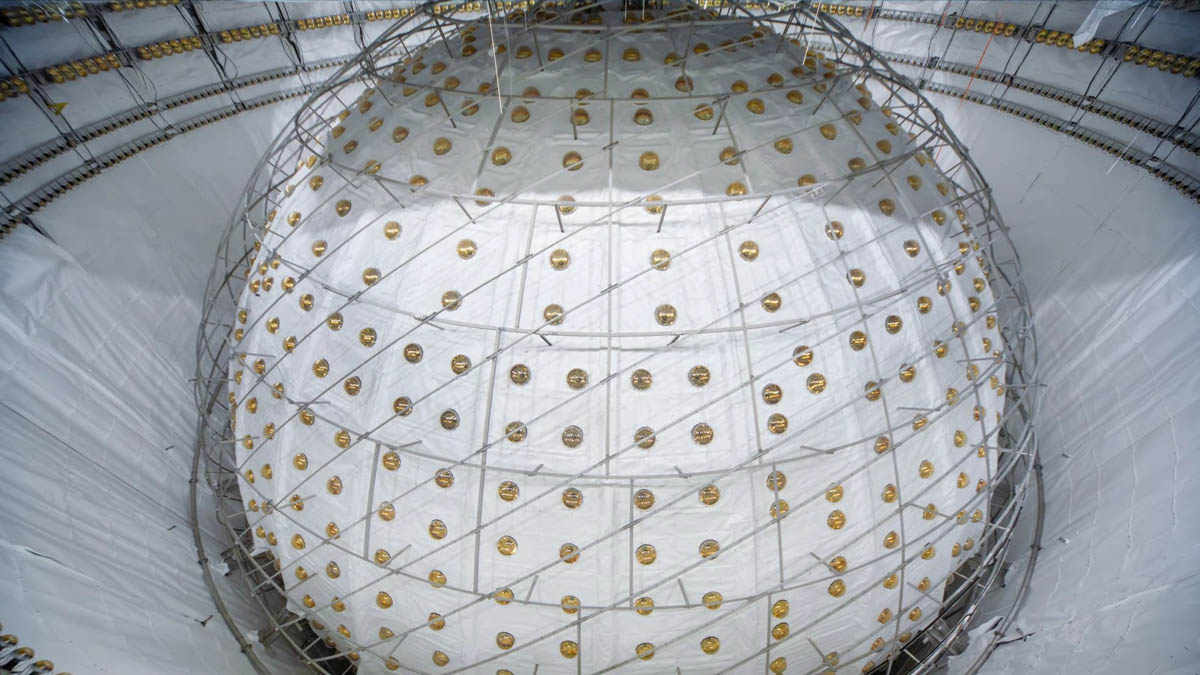
At its core, JUNO represents a marvel of engineering and precision. The detector consists of a 35.4-meter acrylic sphere surrounded by 20,000 large photomultiplier tubes (PMTs) and an additional 25,600 smaller ones, all designed to capture faint flashes of light produced when neutrinos interact with the liquid scintillator. These signals are then converted into electrical data, allowing physicists to study neutrino oscillations and their unique energy spectra.
Beyond mass ordering, JUNO will deliver breakthroughs in several key areas:
- Improving precision of neutrino oscillation parameters by an order of magnitude
- Detecting neutrinos from supernovae, the Sun, and the Earth’s core
- Searching for sterile neutrinos and proton decay, which could reveal entirely new physics
- Laying the foundation for future studies of neutrinoless double-beta decay, which may determine whether neutrinos are Majorana particles—their own antiparticles
Professor Yifang Wang of the Institute of High Energy Physics (IHEP), JUNO’s spokesperson, hailed the project’s completion as “a historic milestone for global science.” Meanwhile, JUNO Chief Engineer Xiaoyan Ma noted the immense technical challenge behind constructing a detector that meets extreme standards of purity and stability, emphasizing the collaboration of more than 700 scientists from 74 institutions across 17 countries.
Conclusion:
The launch of JUNO not only redefines the scale of neutrino research but also demonstrates what global scientific cooperation can achieve. By combining cutting-edge engineering, theoretical insight, and international teamwork, JUNO will help unravel the deepest mysteries of matter and the universe. With a projected lifespan of 30 years and plans for future upgrades, JUNO stands as a monument to human curiosity and perseverance, guiding us closer to understanding the invisible particles that shape existence itself.