


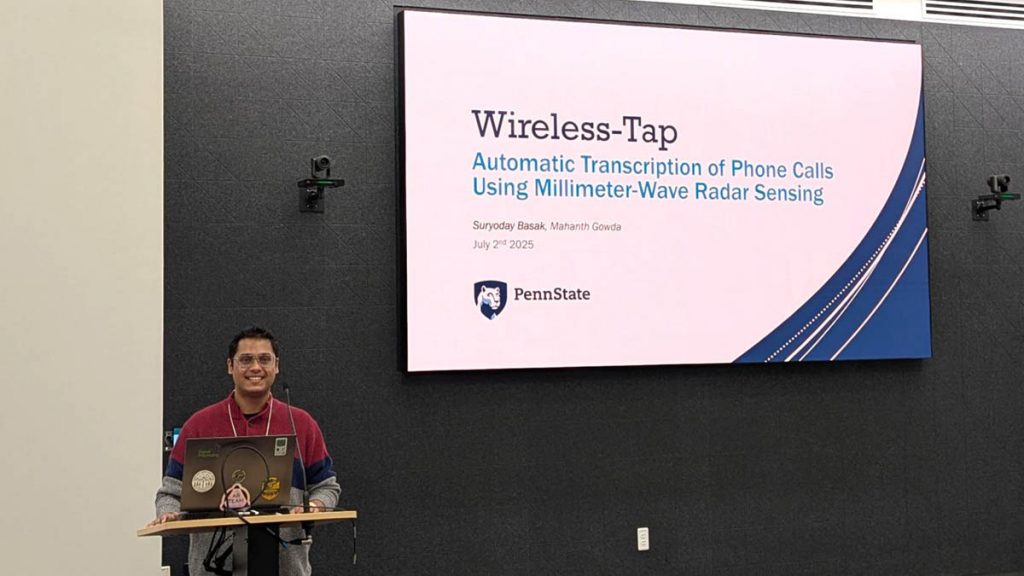
Researchers from Pennsylvania State University have unveiled a groundbreaking yet alarming discovery: the same radar sensors used in autonomous vehicles can be turned into powerful surveillance tools. By detecting the subtle vibrations of a smartphone’s speaker during a call, these sensors can reconstruct audible conversations with surprising accuracy. The experimental system, called WirelessTap, demonstrates how cutting-edge technology can blur the line between convenience and potential espionage.
The foundation of WirelessTap lies in millimeter-wave radar technology, which operates in the 77–81 GHz frequency range. Typically deployed in driver-assistance systems to detect nearby obstacles, these sensors can also capture minuscule vibrations invisible to the human eye. In the experiment, researchers positioned the radar within three meters of a smartphone and successfully captured enough data to reconstruct speech.
The raw signals were far from clear. To make them usable, the researchers processed the noisy radar data through an AI speech recognition model, specifically a customized version of Whisper by OpenAI. This approach enabled them to achieve up to 60% word recognition accuracy, even without any direct access to the target device. The team suggested that incorporating context-aware algorithms—similar to how lip readers use situational cues—could further improve accuracy.
What makes WirelessTap unique is its versatility. Unlike earlier attempts at radar-based eavesdropping, which often required the target to use a loudspeaker or were limited to narrow vocabularies, this system works under more natural conditions. The millimeter-wave sensors are small enough to be embedded in everyday objects, raising serious concerns about covert surveillance possibilities.
The researchers stress that their work was not designed to build spy tools but to highlight vulnerabilities in emerging technologies. As millimeter-wave radar becomes more common in smart devices, homes, and vehicles, the risk of misuse increases. According to their findings, even commercial off-the-shelf radar modules can be adapted for such surveillance experiments.
This discovery underscores the growing overlap between AI, radar technologies, and cybersecurity risks. While AI models like Whisper enhance accessibility and usability, they can also amplify the effectiveness of unconventional spying methods. Governments, businesses, and individuals may need to reconsider how they handle sensitive conversations in environments where advanced sensors are present.
The WirelessTap experiment proves that smartphone conversations can be intercepted without direct hacking, simply by exploiting environmental signals. Though the technology is still limited to research settings, its existence serves as a wake-up call. As innovation advances, so do the methods of surveillance. The challenge now lies in balancing the benefits of millimeter-wave radar with the urgent need for privacy safeguards.