


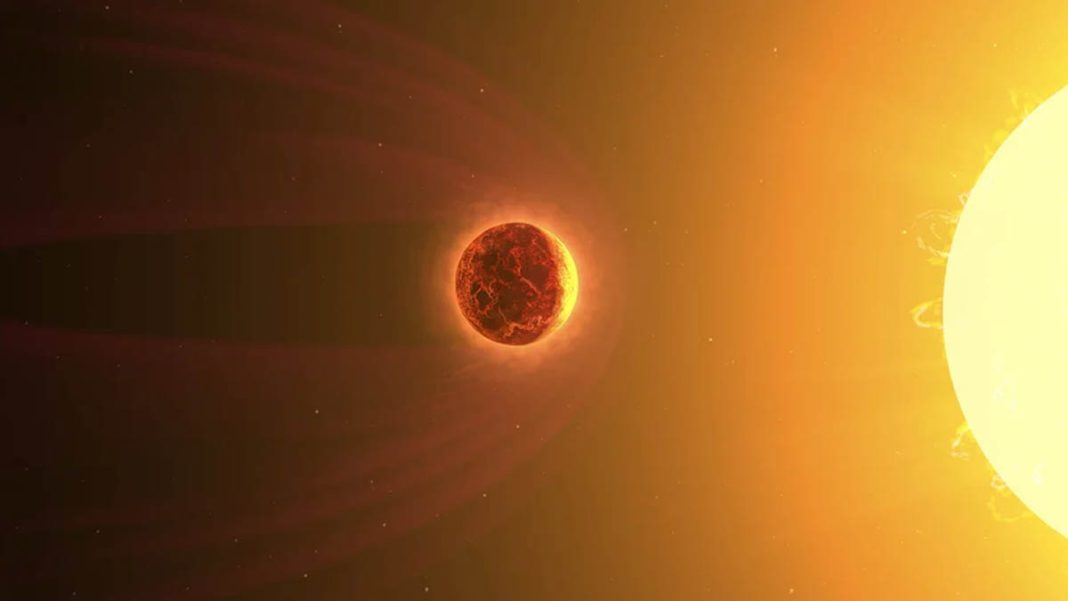
Astronomers have made a groundbreaking discovery with NASA’s James Webb Space Telescope (JWST): an atmosphere surrounding TOI-561 b, a scorching, Earth-sized exoplanet that by all known rules should not have one. This strange and resilient world is rewriting what scientists thought they knew about the conditions required for atmospheres to survive.
TOI-561 b is a rocky planet about twice the mass of Earth, orbiting an orange dwarf star so closely that its year lasts less than a single Earth day. With estimated surface temperatures reaching 2300 Kelvin (over 2000°C), the planet is hot enough to melt rock. According to traditional planetary science, such an environment should strip away any gases, leaving behind a bare, molten world. To complicate matters further, the planet is more than twice as old as our Solar System, meaning it has had billions of years for radiation to erode any possible atmosphere. Yet, observations from Webb tell a different story.
Using JWST’s advanced instruments, scientists measured the temperature distribution between TOI-561 b’s permanent day and night sides. Since the planet is tidally locked, one hemisphere faces its star continuously while the other remains in darkness. The illuminated side was unexpectedly cooler than expected for a barren rock, suggesting that a dense atmosphere is redistributing heat around the planet. This evidence strongly points toward the presence of long-lived gases encasing the exoplanet.
Researchers believe the atmosphere might have originated from the planet’s magma ocean, gradually outgassing volatile compounds over billions of years. While the exact chemical composition remains unknown, scientists suspect it could contain exotic elements different from Earth’s nitrogen and oxygen mix. This mystery adds urgency to future JWST studies, as understanding such atmospheres could reveal crucial clues about the formation of Earth-like planets and even the origins of our own air.
The discovery is remarkable not only because of TOI-561 b’s hostile environment but also because it challenges the longstanding planetary rule: larger, colder planets retain atmospheres, while small, hot planets lose them. Previously, astronomers had tentative evidence of atmospheres on larger lava worlds like 55 Cancri e, but the data was ambiguous. Now, TOI-561 b offers the strongest case yet that even extreme rocky planets can maintain gaseous envelopes.
As astrophysicist Tim Lichtenberg explains, “This planet is very old and very hot. By all logic, it shouldn’t have an atmosphere. And yet, it does.” His colleague Johanna Teske adds that while this detection raises many questions, it may also unlock answers about how atmospheres form, evolve, and survive under unimaginable conditions.
The implications extend beyond TOI-561 b. If atmospheres can persist on worlds once thought impossible, the search for habitable exoplanets may need to be redefined. Moreover, studying such exotic atmospheres helps scientists refine models of Earth’s early history, when our own planet was once a molten sphere with gases escaping from a magma ocean.
Conclusion: The Webb Telescope’s detection of an atmosphere around TOI-561 b marks a historic breakthrough in planetary science. This fiery world defies expectations, proving that atmospheres can endure where theory says they should vanish. By challenging old assumptions, TOI-561 b opens a new frontier in understanding both alien worlds and the atmospheric origins of our own planet.