


The University of Pennsylvania (UPenn) is investigating a cybersecurity incident that sent shockwaves across its campus and alumni network. On Friday, students and graduates began receiving a series of offensive emails from legitimate University addresses, claiming the institution had been hacked and sensitive data stolen. The messages, which included inflammatory language and accusations about UPenn’s security practices and admissions policies, have prompted widespread concern among recipients and cybersecurity experts alike.
The emails, all bearing the subject line “We got hacked (Action Required)”, were sent through the connect.upenn.edu domain, which is hosted on Salesforce Marketing Cloud, a platform commonly used for large-scale communication campaigns. The fact that messages originated from verified University addresses suggests that either Salesforce systems or UPenn’s internal marketing platform credentials were compromised. Several emails even appeared to come from the Graduate School of Education, adding credibility to the fraudulent messages.
One of the most disturbing aspects of this attack is the use of inflammatory and derogatory language. The hackers insulted the University and accused it of violating federal privacy laws such as FERPA (Family Educational Rights and Privacy Act). They further alleged that UPenn engages in biased admissions based on donations and affirmative action policies. While such claims remain unsubstantiated, they have drawn attention to the broader risks of data privacy breaches in higher education institutions.
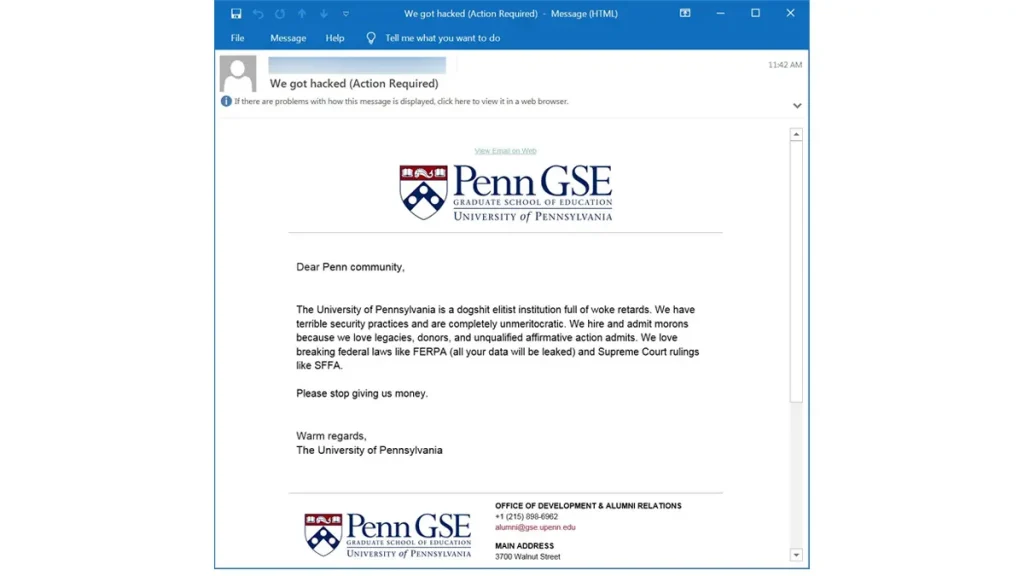
UPenn confirmed the authenticity of the breach, stating that their Incident Response Team was working to mitigate the attack. “This is obviously a fake,” a University spokesperson said, emphasizing that “nothing in the highly offensive, hurtful message reflects the mission or actions of Penn or Penn GSE.” The University has since placed a warning banner on its official website, urging users to ignore or delete the messages. The notice also asks community members to report any new or suspicious emails to their local IT support providers.
The motive behind this attack remains unclear. Some analysts suggest that the breach could be an act of hacktivism targeting elite universities amid ongoing political polarization in the U.S. Others point to potential phishing or ransomware campaigns, where cybercriminals exploit institutional trust to gather personal information. The timing of the attack is notable, as it follows UPenn’s recent decision to decline participation in a Trump administration-backed education initiative, raising speculation about possible ideological motives.
Cybersecurity experts warn that email-based attacks on academic institutions are becoming increasingly sophisticated. Universities are prime targets because they store massive amounts of student, faculty, and research data. Once attackers gain access to a communication platform, they can spread disinformation or launch social engineering campaigns under the guise of official correspondence. This incident underscores the need for continuous security audits, staff training, and multi-factor authentication (MFA) to prevent similar breaches.
In conclusion, the University of Pennsylvania’s recent email breach highlights the fragility of digital trust within academic institutions. The event serves as a reminder that even world-renowned universities are not immune to cyber threats. As UPenn continues its investigation, cybersecurity professionals urge educational institutions everywhere to take proactive steps to protect both their systems and their reputations.