


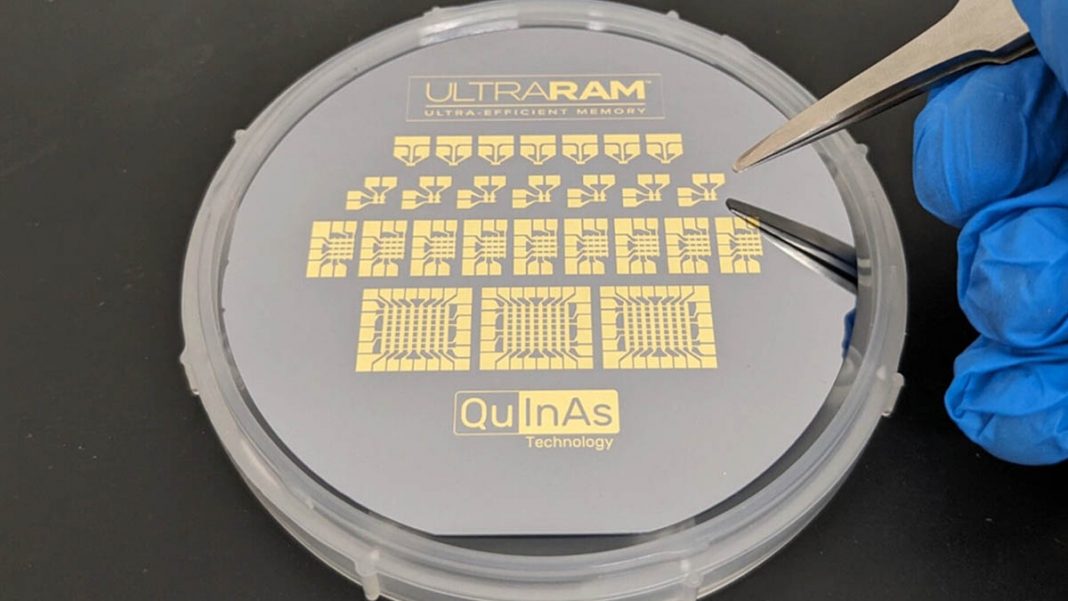
The race to redefine computer memory is reaching a breakthrough, as UltraRAM technology moves one step closer to large-scale manufacturing. Developed by Quinas Technology in collaboration with IQE plc, this innovation promises to merge the speed of DRAM with the endurance and persistence of non-volatile storage, potentially reshaping the global semiconductor landscape.
For decades, the computing industry has relied on two main types of memory: volatile DRAM, known for speed but requiring constant power, and non-volatile NAND flash, valued for storage but limited in endurance. UltraRAM blurs this boundary by combining both strengths. According to recent reports, UltraRAM can deliver DRAM-like performance, endure 4,000 times longer than NAND, and preserve data for up to a thousand years.
The progress is not just theoretical. The companies have successfully demonstrated a scalable epitaxy-based process—a method where precise semiconductor layers are grown onto a crystalline substrate. Once formed, traditional techniques like photolithography and etching can be applied to manufacture UltraRAM memory chips at industrial scale. This achievement, described as a pivotal milestone, brings UltraRAM from laboratory experimentation to the threshold of commercial viability.
Quinas Technology’s CEO James Ashforth-Pook described this step as a turning point, marking the transition from university research to commercial products. Meanwhile, IQE CEO Jutta Mayer emphasized the significance of this project for the UK semiconductor industry, highlighting its role in advancing next-generation quantum materials.
The memory itself is built on a quantum-mechanical phenomenon known as resonant tunneling, making it the first memory of its kind to use this approach. Early demonstrations showcased prototypes at Lancaster University in 2022, later validated in 2023 during hands-on evaluations at UltraRAM labs. Now, the technology is moving towards pilot production partnerships with semiconductor foundries and photolithographic facilities.
If UltraRAM reaches the market, it could disrupt data centers, personal computing, and mobile devices by reducing energy consumption, extending device lifespans, and eliminating the performance trade-offs between DRAM and flash. Such a shift would not only boost performance but also reduce the environmental footprint of global memory production.
Conclusion: UltraRAM is no longer just a promising concept—it is a practical reality edging closer to commercialization. With its unprecedented speed, endurance, and data retention, UltraRAM could become the universal memory standard, replacing the fragmented use of DRAM and NAND. This innovation may redefine how computers, servers, and storage systems are built for generations to come.