

Trump’s New AI Directives Aim to Eliminate “Woke” Bias — But Critics Say It’s Politically Charged
In a sweeping move that has reignited debate over bias in artificial intelligence, former U.S. President Donald Trump signed three new executive orders focused on reshaping how AI is developed and used within the federal government. The directives aim to create what he describes as a more “truthful and unbiased” approach to AI — but critics warn that the plan may actually push a political agenda under the guise of objectivity.
The Heart of the Orders: Preventing “Woke AI”
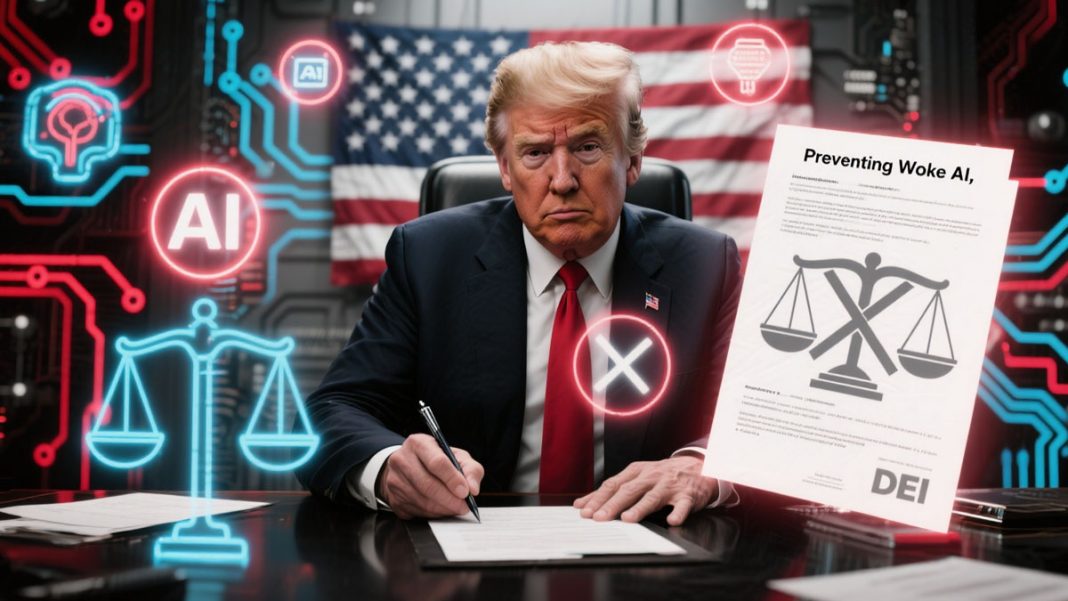
The most controversial of the three orders is titled “Preventing Woke AI in the Federal Government.” It demands that all AI systems used by federal agencies avoid “sacrificing truth and accuracy for ideological goals.” This includes banning developers from deliberately embedding ideological viewpoints, such as diversity, equity, and inclusion (DEI) principles, unless explicitly requested by users.
Trump emphasized the need to remove bias from government AI systems, saying:
“We are banning AI technologies with partisan or ideological programming. From now on, government AI will prioritize truth, fairness, and neutrality.”
The order has already sparked heated debate among experts and civil rights advocates, who argue that true neutrality in language and data is impossible. They warn that such mandates risk silencing important perspectives under the pretense of eliminating bias.
A Push to Remove Federal “Barriers” to AI Growth
Another executive order outlines plans to accelerate AI innovation by rolling back what Trump calls “burdensome federal regulations.” This deregulatory approach is intended to stimulate private sector development and attract more investment into the domestic AI industry.
In line with that, a third directive unveils an ambitious strategy dubbed the “American AI Export Program,” which aims to promote U.S.-developed AI technologies overseas. This plan supports the expansion of American AI tools across international markets, countering the global rise of Chinese AI platforms.
Critics Say “Objectivity” Is a Political Smokescreen
AI experts and scholars are pushing back, claiming that the orders reflect a narrow and politically motivated interpretation of what counts as “truth” or “bias.”
Dr. Philip Seargeant, a senior lecturer at the Open University, notes:
“Language and AI can never be truly neutral. The idea of pure objectivity is a fantasy.”
The administration’s targeting of “woke” values raises concerns that only perspectives aligned with Trump’s ideology will be allowed, while others could be marginalized or labeled as biased.
Rumman Chowdhury, former U.S. AI envoy and head of the nonprofit Humane Intelligence, points out that:
“What this really does is weaponize the idea of neutrality to exclude opposing viewpoints. It’s selective censorship disguised as policy.”
She also warned that such policies may lead tech companies to alter their AI training datasets to align with government standards, effectively compromising the integrity of AI development.
Grok, Musk, and Government Partnerships: The Hypocrisy?
Ironically, Trump’s administration recently inked a major federal contract with Elon Musk’s Grok AI, which critics say is itself politically charged. Grok is known for avoiding mainstream news sources, promoting “non-woke” opinions, and reflecting Musk’s own controversial stances.
Legal scholars like Stanford’s Mark Lemley ask whether Grok will also be subject to scrutiny under these new orders, or whether the rules are selectively enforced.
“If Grok gives politically skewed answers and isn’t penalized, then this is clearly about silencing certain views — not eliminating bias,” said Lemley.
America’s AI Race: Infrastructure, Deregulation, and National Security
The three executive orders are part of a broader plan titled “Winning the AI Race: America’s AI Action Plan,” which includes 90 policy proposals to assert U.S. leadership in AI. The initiatives cover:
- Building large-scale infrastructure such as data centers and chip manufacturing plants
- Deregulation efforts to eliminate state-level restrictions on AI development
- Limiting federal risk assessments on topics like DEI, climate change, or misinformation
- Supporting open-source AI models and startups through partnerships and grants
- Strengthening national security with AI integration into defense and intelligence systems
- Restricting AI chip exports to China and tracking tech developments in “hostile” nations
These moves signal a geopolitical strategy to maintain America’s edge in AI while limiting influence from foreign competitors.
Conclusion: Neutrality or Narrative Control?
Trump’s AI executive orders claim to promote fairness and factuality, but they have already stirred fears of ideological overreach and selective censorship. By attempting to legislate “truth” in AI, the administration may be opening the door to exactly the kind of political manipulation it says it wants to prevent. With federal contracts being handed to politically aligned platforms like Grok, critics argue that the line between bias prevention and narrative control is growing dangerously thin.