


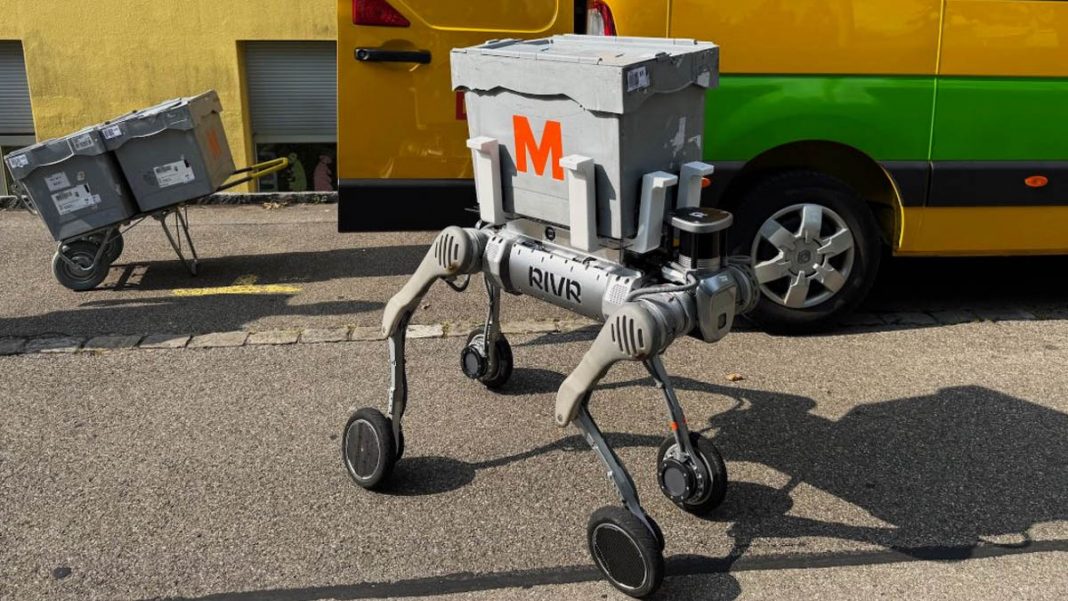
Switzerland has taken another step toward the future of autonomous logistics. In the municipality of Regensdorf, Swiss Post, together with online retailer Migros Online and robotics manufacturer RIVR, has officially launched a new service: the delivery of groceries and parcels using robotic couriers.
The technology behind this project is driven by ANYmal, a four-legged robot originally developed at the Swiss Federal Institute of Technology in Zurich (ETH Zurich). Unlike traditional delivery robots, ANYmal can switch between walking and rolling modes. Its legs can be equipped with wheels, which when locked act as sturdy treads for climbing stairs and crossing uneven terrain. When the wheels rotate freely, the robot moves quickly and efficiently across flat surfaces. This dual-mode design makes it one of the most versatile robots in the field of urban delivery.
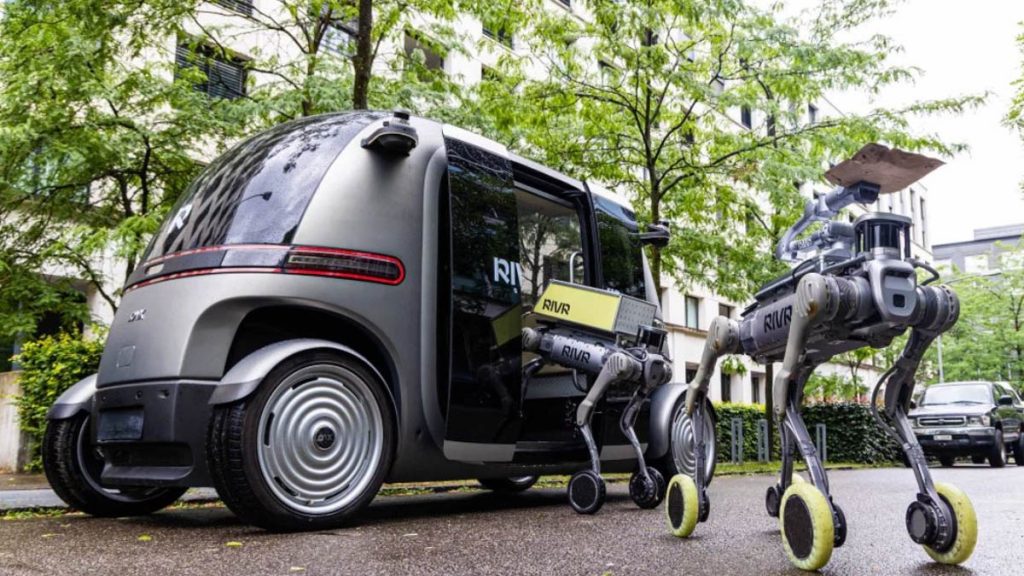
The commercial version, known as RIVR ONE, is produced by the robotics company RIVR (formerly Swiss-Mile), a spin-off from ETH Zurich. Equipped with lidar sensors, optical cameras, and GPS systems, RIVR ONE is capable of navigating city streets autonomously. It carries packages in a secure cargo container mounted on its back, ensuring both safety and efficiency during last-mile deliveries.
The current trial in Regensdorf involves a hybrid delivery process. Robots are first transported in Swiss Post vans to designated areas, from where they autonomously deliver parcels and groceries to customers’ doorsteps. While the robots operate independently, human supervisors are on standby to take control if unexpected situations arise.
According to Pascal Stalder, project manager at Swiss Post, this initiative aims to evaluate how autonomous delivery systems can support employees, reduce the need for long walking distances, and minimize the physical strain of carrying heavy packages—all while maintaining the high service standards expected by Swiss customers.
This is not the first time Switzerland has tested robotic delivery. Earlier this year, similar robots were used for food delivery in Zurich and even parcel delivery in Austin, Texas. The ANYmal platform has also gained attention for its remarkable mobility: in 2024, it demonstrated parkour-like skills, including jumping across gaps, climbing barriers, and crouching under obstacles. Such advanced capabilities make it well-suited for the challenges of real-world environments.
Conclusion
The Swiss Post robotic delivery project shows how robotics, AI, and logistics are converging to reshape last-mile delivery. By integrating autonomous couriers into urban infrastructure, Switzerland is setting a strong precedent for how future supply chains could operate—more efficient, less labor-intensive, and increasingly sustainable. If successful, this pilot could pave the way for widespread adoption of robotic delivery solutions across Europe and beyond.