


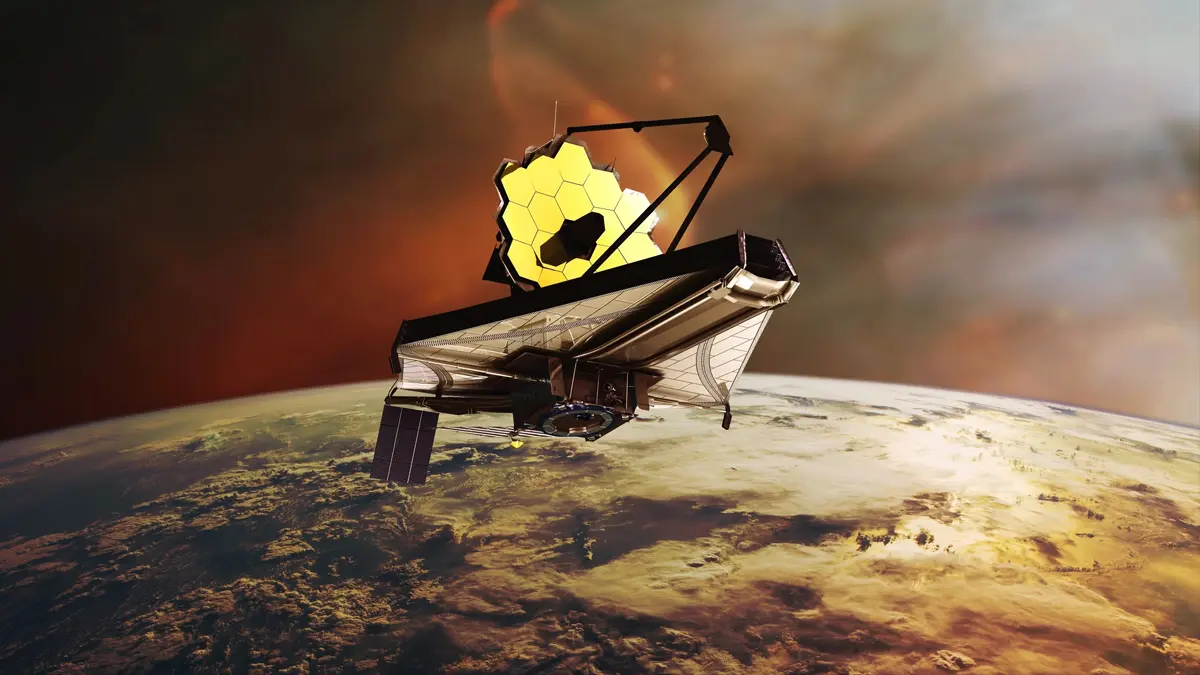
In a remarkable technological breakthrough, scientists from the University of Sydney have managed to repair the James Webb Space Telescope (JWST) without launching a single astronaut into space. Using an advanced artificial intelligence system called AMIGO (Aperture Masking Interferometry Generative Observations), the team successfully corrected a subtle electronic distortion that had been causing slight image blurring in one of JWST’s most sensitive instruments. The fix has fully restored the telescope’s ability to capture ultra-clear images of distant exoplanets and cosmic phenomena—marking a new era in AI-driven space maintenance.
The researchers behind this innovation, Louis Desdoigts and Max Charles, achieved what previously would have required a complex and costly space mission. Inspired by their success, the duo even commemorated the event with matching tattoos of the telescope they “repaired from Earth.” Their work focused on improving the Aperture Masking Interferometer (AMI)—the only JWST component developed in Australia, originally designed by Professor Peter Tuthill from the Sydney Institute for Astronomy. AMI plays a key role in achieving extremely sharp views of stars and exoplanets by masking and calibrating light interference patterns.
Early in JWST’s operation, astronomers noticed that faint electronic distortions within its infrared detector were slightly blurring AMI’s images. This issue was reminiscent of the early optical problem experienced by the Hubble Space Telescope, which required a manned mission to physically repair it in orbit. In contrast, the Sydney team’s solution involved no hardware replacement—only advanced software calibration.
The AMIGO system uses AI-based modeling and neural networks to simulate the behavior of the telescope’s optics and electronics. After detecting that electrical charges were leaking into adjacent pixels, the algorithm recalibrated the affected data, eliminating the distortion and restoring AMI’s precision. As a result, JWST can now produce sharper images than ever before—enabling it to detect faint celestial bodies such as a dim exoplanet and a brown dwarf orbiting the star HD 206893, located about 133 light-years from Earth.
The team’s achievement has already produced stunning results. Under the guidance of Max Charles, JWST’s updated AMI has captured high-resolution images of a black hole jet, the volcanic surface of Jupiter’s moon Io, and the dusty stellar winds of WR 137. These observations not only highlight the telescope’s renewed power but also demonstrate how AI can revolutionize space exploration by remotely maintaining and enhancing instruments that are millions of kilometers away.
In conclusion, this success story proves that artificial intelligence is becoming an indispensable tool in modern astronomy. What once required astronauts and spacecraft can now be handled through data-driven intelligence from Earth. The University of Sydney’s innovative AMIGO project has shown that AI doesn’t just help us explore the universe—it’s now helping us maintain the tools that make that exploration possible.