


Scientists Develop Robots to Explore Lava Tubes on Mars and the Moon
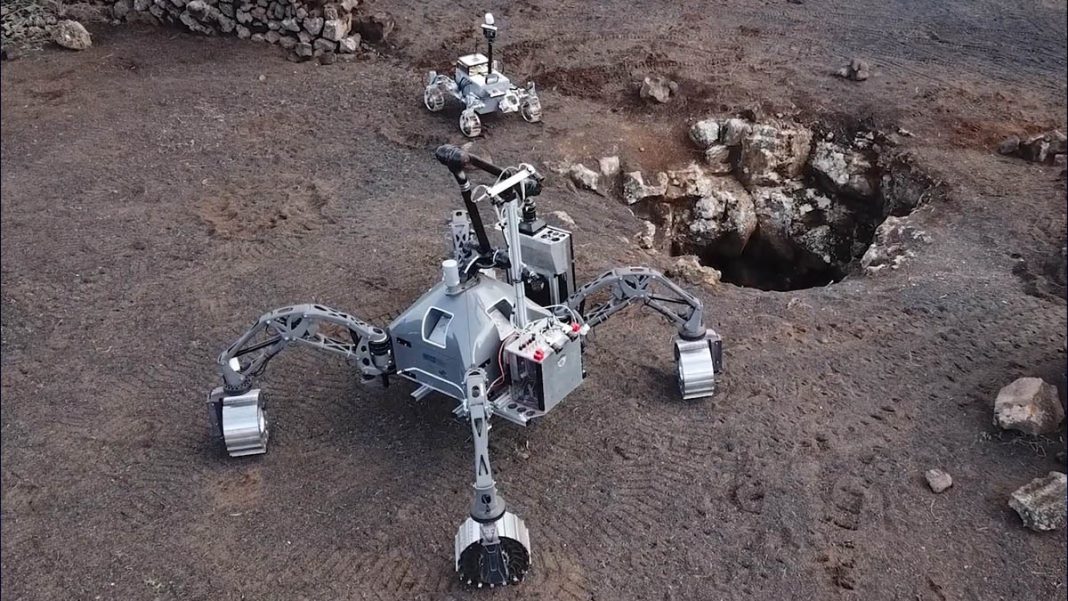
A team of international researchers has unveiled robotic systems designed to descend into the depths of Mars and the Moon, offering groundbreaking possibilities for space exploration and future colonization. The trials were recently conducted on the volcanic terrain of Lanzarote, Spain, where researchers tested how these robotic explorers could navigate harsh underground environments.
Lava Tubes: Natural Shelters for Future Astronauts
Lava tubes form when molten lava flows beneath a hardened crust, leaving behind hollow tunnels once the eruption ends. Satellite observations have revealed the presence of such lava tunnels beneath the surfaces of both Mars and the Moon, sparking interest in their potential use. Scientists believe these caves could serve as safe habitats for astronauts, protecting them from harmful cosmic radiation, solar storms, and micrometeorites. In addition, these environments may be promising locations to search for traces of ancient microbial life.
How Robots Are Tested for Extraterrestrial Missions
To simulate extraterrestrial missions, researchers from the University of Malaga designed a four-stage strategy to test robotic cooperation. First, two rovers mapped the area around a cave entrance. Then, one rover deployed a cubesat-like probe into the cave to create a 3D model of the entrance. Using this detailed map, the robots determined the best descent path.
The next step posed the greatest challenge: the rovers had to work autonomously and independently. The smaller rover attached itself to the larger one and began a controlled descent into the cave. Once detached, it traveled 235 meters through rugged terrain, generating a high-resolution 3D map of the underground passage.
Communication Challenges in Subsurface Exploration
One of the biggest obstacles in exploring vast cave systems is maintaining communication. Radio waves cannot penetrate rock layers, making it difficult for robots to stay connected with mission control. Overcoming this issue will be essential for deploying larger teams of robots to map out and prepare underground habitats on Mars or the Moon.
Why This Matters for the Future of Space Exploration
This pioneering research, published in Science Robotics, demonstrates that robotic systems could one day pave the way for sustainable human settlements on Mars and the Moon. By proving that autonomous rovers can explore and map lava tubes, scientists have taken a critical step toward securing safe environments for astronauts beyond Earth.
Conclusion
As humanity prepares for its next giant leap, robots will play a central role in opening the door to new worlds. By exploring the hidden landscapes beneath alien surfaces, these machines may help us find safe shelters, discover signs of past life, and build the foundations of future space colonies. The road to Mars and the Moon may begin underground.