


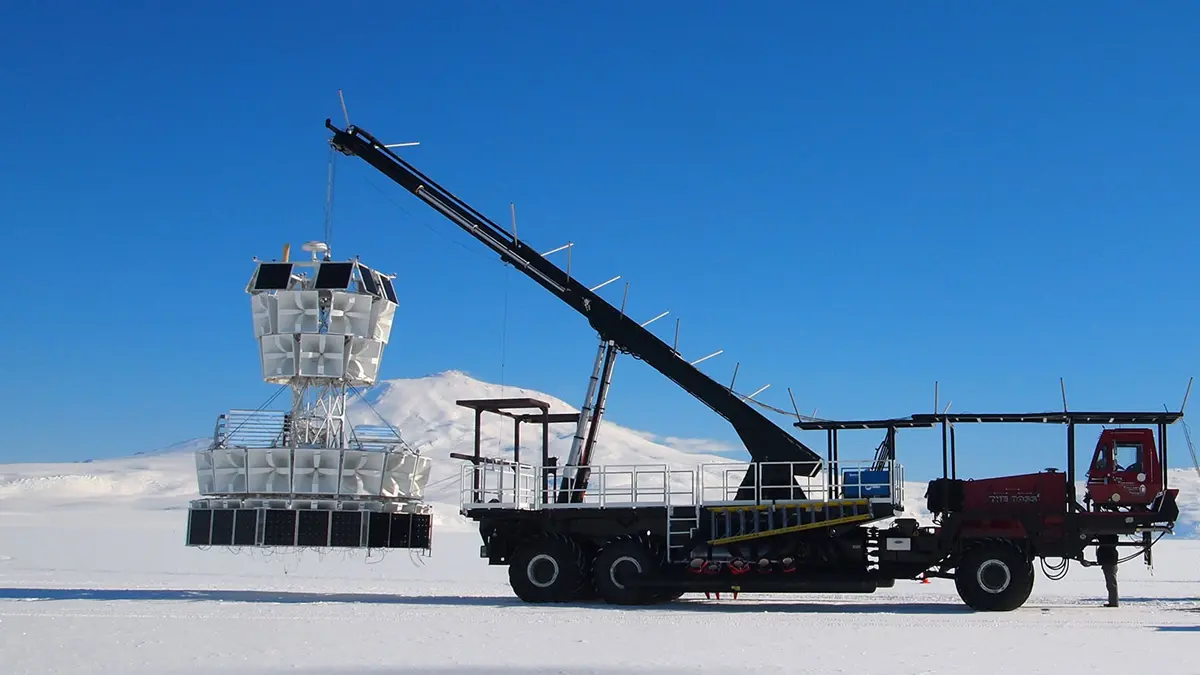
For nearly a decade, NASA scientists have been puzzled by a series of mysterious radio signals detected beneath the frozen expanse of Antarctica. Using the Antarctic Impulsive Transient Antenna (ANITA) — a high-altitude balloon-based detector — researchers recorded strange radio bursts between 2016 and 2018 that defy current models of particle physics. The anomalies suggest signals emerging not from above the ice, as expected, but from below it — an observation that challenges our fundamental understanding of how cosmic rays interact with Earth.
ANITA, launched by NASA, was designed to detect radio waves generated when cosmic particles strike the Earth’s atmosphere. Typically, these high-energy interactions create downward-traveling signals that bounce off the ice before reaching the detector. However, some of ANITA’s readings appeared to originate upward, suggesting something beneath the Antarctic surface was producing them — a result so strange that scientists initially speculated they might have stumbled upon undiscovered particles or even a new kind of physics.
According to Dr. Stephanie Wissel, a physicist from the ANITA collaboration, these signals were detected at angles nearly 30 degrees below the ice surface, meaning they would have had to pass through thousands of kilometers of solid rock. “Under normal conditions, radio waves would be completely absorbed,” Wissel explained. “This makes the phenomenon extremely puzzling.”
While the idea of new particles once excited the scientific community, further studies have cast doubt on that theory. Researchers from the Pierre Auger Observatory in Argentina analyzed 15 years of cosmic ray data and found no similar events. Wissel clarified that while ANITA’s observations remain unexplained, they are unlikely to represent neutrinos — elusive subatomic particles that rarely interact with matter. “It’s a fascinating mystery,” she said, “but all signs indicate these are not neutrinos as we know them.”
Neutrinos, sometimes called the “ghost particles” of the universe, pass through everything — from human bodies to entire planets — without leaving a trace. Every second, billions of them travel through your thumbnail, but detecting even one requires immense precision. Instruments like ANITA and IceCube in Antarctica are designed to catch the rare moments when a neutrino interacts with ice, producing detectable radio or light signals.
Wissel’s team believes that understanding these anomalies could unlock vital information about cosmic events, such as supernovae or distant gamma-ray bursts. They are now developing a more advanced detector called PUEO, which will have greater sensitivity to detect ultra-high-energy particles and verify the source of these signals. “If these signals truly come from something unknown beneath the ice,” Wissel added, “it could completely reshape our understanding of particle physics.”
Conclusion:
The strange radio bursts recorded by NASA’s ANITA experiment continue to baffle scientists. Whether they represent unknown particle interactions, exotic cosmic phenomena, or simply misunderstood radio effects remains an open question. But one thing is certain — Antarctica’s frozen desert may be hiding secrets that could redefine our understanding of the universe. The upcoming PUEO mission might finally help solve one of modern physics’ most intriguing puzzles.