


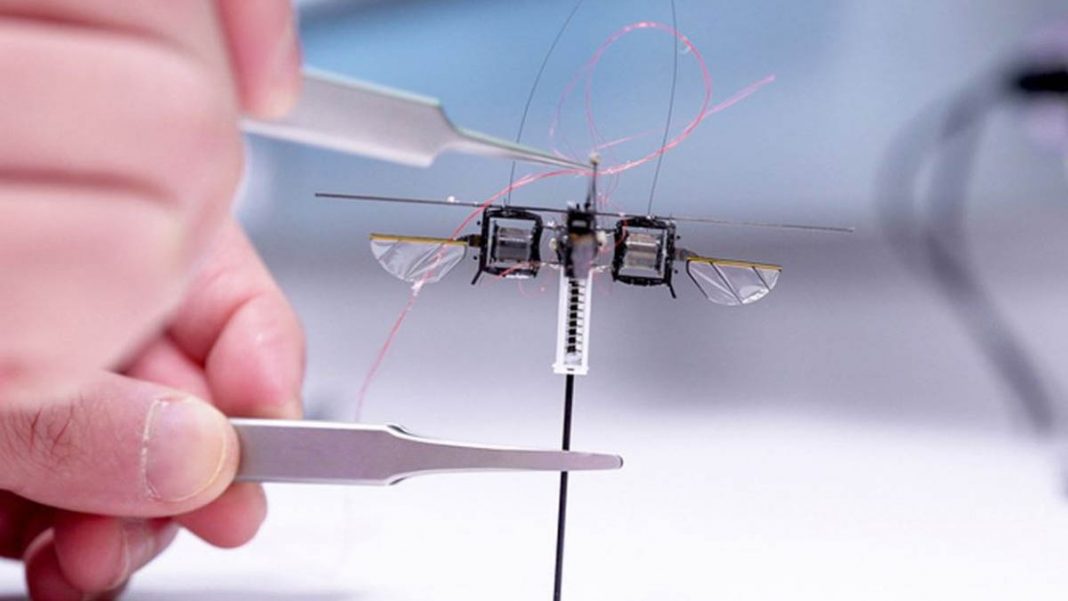
A group of brilliant MIT students has unveiled a groundbreaking innovation: a robotic bee weighing less than a paperclip, designed to mimic the complex flight patterns of real bumblebees. This robo-bee is part of a future fleet of miniature robots capable of crawling, flying, and jumping to perform specialized tasks both on Earth and in space.
Despite its tiny size—less than one gram—the robot can flap its wings up to 400 times per second, achieving a flight speed of two meters per second. According to graduate researcher I-Hsuan Hsiao, the team’s primary goal was to replicate the agile maneuvers of real bees, including hovering, flipping, and precision flight.
The wings are powered by soft artificial muscles that contract and extend, giving the robot lifelike motion capabilities. MIT robotics professor Kevin Chen explained that the design aims to provide a machine resilient enough to operate in challenging scenarios and emergency conditions. Unlike conventional drones, the robo-bee’s lightweight design and muscle-driven wings allow for enhanced control and energy efficiency.
One of the most promising applications is artificial pollination. As natural pollinators face population decline worldwide, robotic bees could serve as backup pollinators for farms of the future. This technology could also be vital in extraterrestrial agriculture, where transporting live insects for pollination may not be feasible. “If you’re trying to grow food on Mars, you probably don’t want to bring natural bees,” Hsiao noted.
The MIT team is not stopping with the bee. They are also developing a grasshopper-inspired robot, smaller than a human thumb, capable of jumping 20 centimeters at a speed of 30 centimeters per second. This robo-grasshopper can even hover like a drone while consuming 60% less energy than comparable aerial robots, making it highly efficient for long-term operations.
Beyond agriculture and space, researchers envision critical roles for these insect-sized machines in search-and-rescue missions, such as navigating collapsed buildings after earthquakes, or conducting pipeline inspections in confined industrial spaces. Their agility, energy efficiency, and small size give them advantages that traditional robots cannot match.
Conclusion
The MIT robo-bee is more than a student experiment—it is a glimpse into the future of robotics, agriculture, and space colonization. With applications ranging from pollination to emergency response, these insect-scale robots could one day be as essential to humanity as drones are today. What began as an academic project may soon redefine how humans approach challenges on Earth and beyond.