


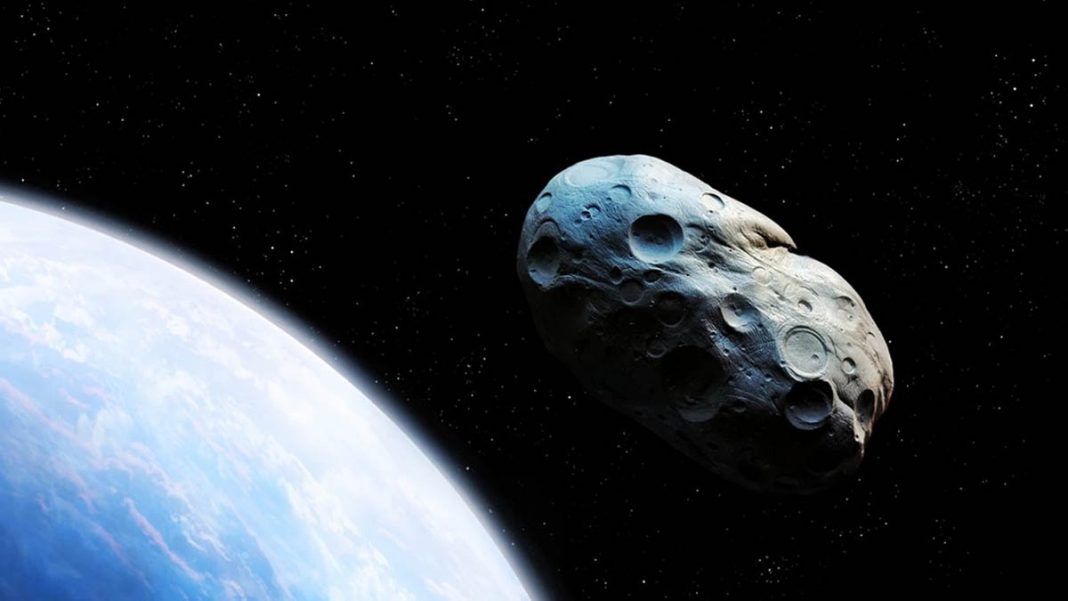
The asteroid 2025 FA2, measuring between 130 and 290 meters in diameter, has safely passed Earth and is now moving away from our planet. At its closest point, the asteroid was approximately 800,000 kilometers from Earth, a distance just over twice that between the Earth and the Moon. While initial observations raised concerns of a potential impact, further tracking confirmed that there was no risk of collision.
The asteroid was first detected in March 2025 using the Pan-STARRS 2 telescope. Early data placed 2025 FA2 on the European Space Agency’s risk list due to a small probability of impact. However, subsequent observations allowed astronomers to refine its orbital path and rule out the possibility of a crash.
During its flyby, 2025 FA2 traveled at a speed of 38,800 km/h and had a mass estimated to be 1,000 times greater than the Chelyabinsk meteorite that exploded over Russia in 2013. This comparison highlights the enormous destructive potential the asteroid would carry if it ever collided with Earth. Fortunately, the object’s current trajectory ensures our planet’s safety.
Interestingly, while 2025 FA2 moves further away, its apparent brightness in the sky is increasing. The asteroid initially crossed Earth’s orbit from the inner side, illuminated only partially by the Sun. Now, with the Sun shining directly on it from behind Earth, the asteroid is fully illuminated, making it appear brighter. Astronomers expect it to reach its peak brightness on September 20–21, achieving magnitude 15, which is not visible to the naked eye but detectable with telescopes of 30 cm aperture or more.
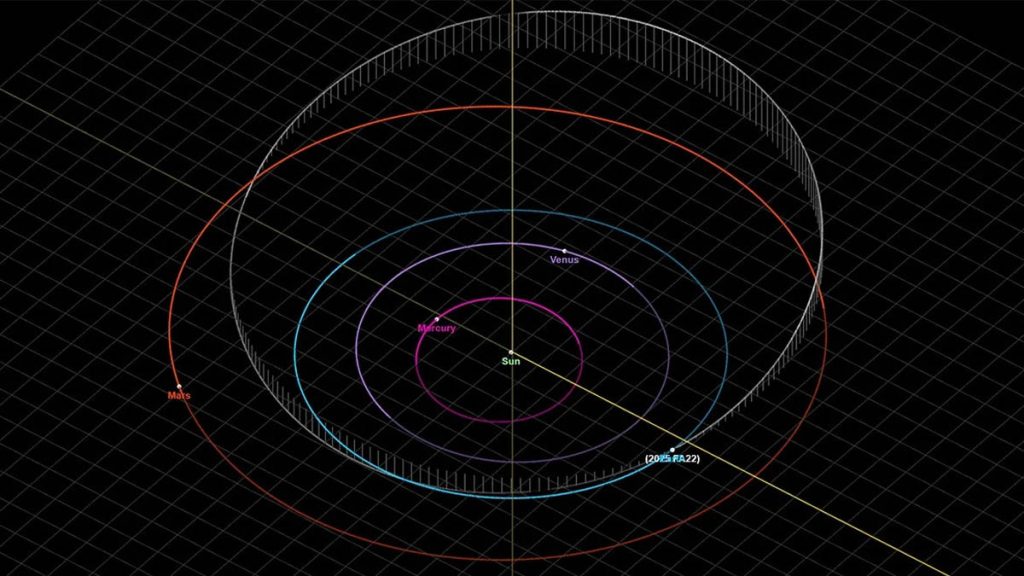
Looking ahead, 2025 FA2 will return on August 20, 2026, but at a much greater distance—25 times farther from Earth. Potentially hazardous approaches are predicted for 2089 and 2173, though orbital shifts over time may change these predictions. The asteroid belongs to the Apollo group, completing one orbit around the Sun every 676 days, with distances ranging from 132 million km at perihelion to 319 million km at aphelion.
Conclusion:
The safe passage of asteroid 2025 FA2 serves as a reminder of the importance of ongoing asteroid detection and monitoring programs. While no immediate danger exists, astronomers continue to track its path closely to better predict future encounters. The event demonstrates both the power of modern space observation technology and the need for vigilance in understanding near-Earth objects that could pose risks in the distant future.