

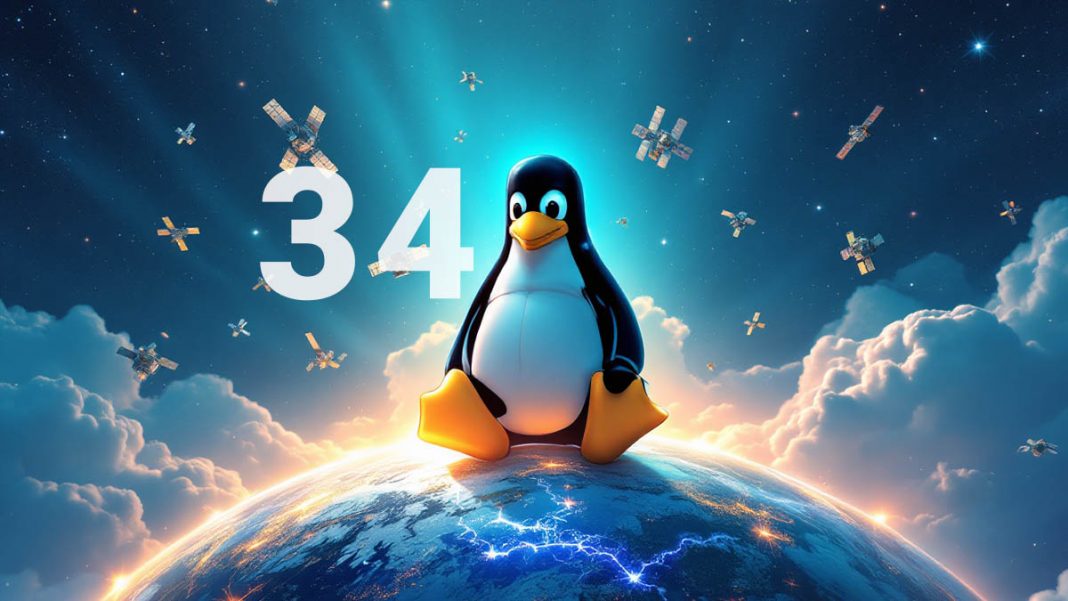
On August 25, 2025, the Linux operating system celebrated its 34th anniversary, marking more than three decades since its first release by Linus Benedict Torvalds. What started in 1991 as a “just-for-fun” side project by a 21-year-old computer science student at the University of Helsinki has become the backbone of modern computing, powering everything from smartphones and servers to supercomputers and even systems on the International Space Station and Mars.
On August 25, 1991, Torvalds posted a now-legendary message in the comp.os.minix newsgroup, describing his “free operating system” for 386 AT-clones. At the time, he emphasized that it was a hobby project, not something at the level of GNU, but within months Linux became usable and started attracting global developer interest. Torvalds had already ported bash 1.08 and gcc 1.40, laying the foundation for a fully functional system. That message, humble in tone, is now part of computer science history.
Over the past 34 years, Linux has become an open-source powerhouse maintained not only by Torvalds but also by thousands of contributors worldwide. Today, billions of devices—from microcontrollers to enterprise data centers—run on Linux. Its modularity and flexibility make it the preferred system for cloud infrastructure, embedded devices, high-performance computing, and mobile platforms like Android.
In 2024, the Linux Foundation reported that spending on kernel development dropped to 2.3% of its total expenses, down from 2.9% in 2023 and 3.2% in 2022. Development costs for the Linux kernel in 2024 amounted to $6.8 million, a reduction compared to previous years. This demonstrates the efficiency of collaborative open-source development, where global contributions spread the workload and reduce organizational overhead.
On July 27, 2025, Torvalds announced the release of Linux kernel 6.16, codenamed Baby Opossum Posse. Shortly after, he sparked debate in the developer community by strongly rejecting certain proposed RISC-V architecture changes for the upcoming 6.17 kernel, bluntly calling them “garbage.” This highlights both the technical rigor and the uncompromising standards that keep Linux stable, secure, and performant.
One of the most discussed issues in the Linux community is what happens when Torvalds eventually steps back. Despite being the symbolic and practical leader of the project for decades, Torvalds has dismissed the need for a formal succession plan, stating that trust in the community will ensure a natural transition. In his own words: “The next benevolent dictator will emerge on their own.”
Conclusion
As Linux enters its fourth decade, it stands as one of the most significant achievements in modern computing—an operating system born from a hobbyist’s idea that became the foundation of global digital infrastructure. With continuous innovation, an active developer community, and unmatched adaptability, Linux remains the heartbeat of the open-source world and will likely continue shaping the future of technology for decades to come.