


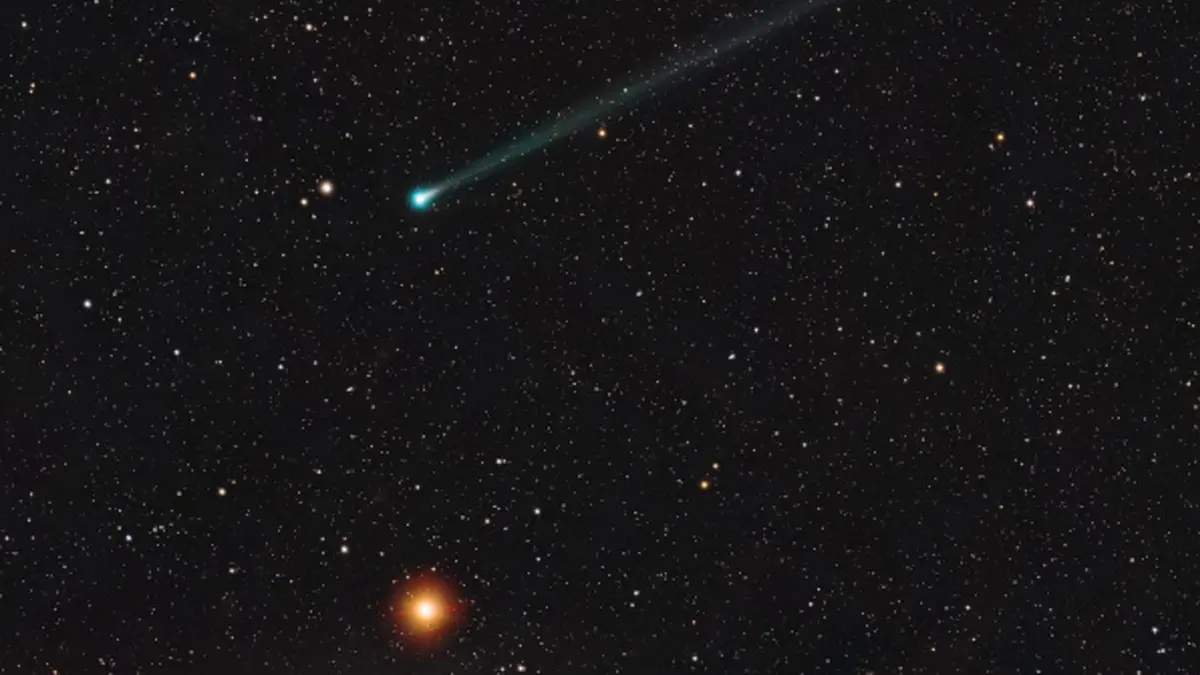
The mysterious interstellar comet 3I/ATLAS has captured the attention of astronomers once again, as new observations suggest it remained intact after passing the Sun, contrary to previous reports that it might have exploded or fragmented. Early speculations by some researchers claimed the comet disintegrated during its close approach to the Sun, but recent telescope data indicate otherwise — the comet appears to have survived the intense solar radiation.
Reports from Futurism and a blog post by Harvard astrophysicist Avi Loeb had previously suggested that 3I/ATLAS lost a significant portion of its mass, possibly breaking apart after perihelion — the closest point to the Sun in its orbit. Loeb’s analysis, based on images taken by two small telescopes in Spain, led him to speculate that the object might even be an extraterrestrial spacecraft. However, most experts strongly disagree, emphasizing that all evidence points to a natural interstellar comet rather than an alien probe.
According to Cichen Zhang, a research fellow at the Lowell Observatory in Arizona, the comet shows no signs of disintegration. “In every image I’ve seen, the comet looks entirely normal and structurally sound. There are no indicators that the nucleus has split,” Zhang stated. His assessment effectively debunks earlier claims that 3I/ATLAS had exploded.
On October 29, the comet reached its perihelion, and astronomers have since been observing it closely to analyze its composition. As it nears the Sun, the ice on its surface sublimates into gas, creating massive jets that form a bright halo known as the coma. This phenomenon, amplified by solar ionization, allows both professional and amateur astronomers to observe and study the comet’s structure in detail.
Currently, 3I/ATLAS is climbing higher above the eastern horizon and can be seen through small telescopes across much of the Northern Hemisphere. Most astronomers agree that this interstellar visitor is a regular comet originating from another star system within the Milky Way. Recent amateur photographs by Michael Buechner and Frank Niebling even captured visible gas jets streaming from the comet, confirming its ongoing activity and stability.
Meanwhile, Loeb continues to argue that the comet’s observed acceleration and mass loss are inconsistent with traditional cometary behavior, implying a possible artificial origin. Yet, other scientists, including Jason Wright, professor of astronomy and astrophysics at Pennsylvania State University, have dismissed these claims. Wright publicly refuted Loeb’s assertions, labeling them as misinterpretations of orbital data and reaffirming that no evidence supports an artificial structure.
3I/ATLAS is expected to reach its maximum distance from Earth on December 19, and ongoing monitoring will provide valuable insights into the nature of interstellar bodies. The event serves as a reminder of the scientific curiosity and debate that often accompany groundbreaking cosmic discoveries.
In conclusion, while bold theories have stirred intrigue, the scientific consensus remains firm: 3I/ATLAS is a natural interstellar comet that endured its journey past the Sun. Its survival not only expands our understanding of cosmic materials and interstellar trajectories, but also underscores the resilience of these icy wanderers that traverse the vast expanse of our galaxy.