


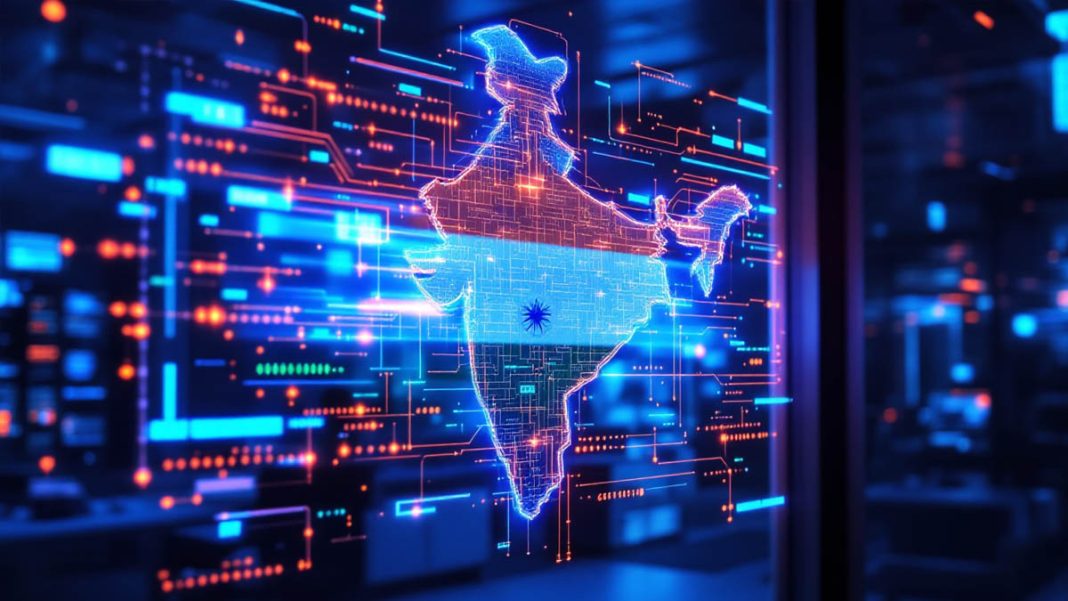
India is rapidly positioning itself as one of the most important players in the global artificial intelligence (AI) revolution. With nearly 900 million internet users, the country represents not only one of the largest digital markets after China but also one of the most open ecosystems for U.S. and global tech firms. Unlike China, which maintains strict controls, India has welcomed companies such as OpenAI, Microsoft, Google, and Meta, making it a crucial testing ground for AI-driven services and products.
OpenAI CEO Sam Altman has expressed strong optimism about India’s role in shaping the future of AI, noting that the pace of AI adoption in the country is unmatched globally. OpenAI has already launched a localized subscription at $4.6 per month, compared to $20 in most other markets, signaling a strategy focused on scale and accessibility. The company plans to open a New Delhi office in 2025 and is reportedly exploring the creation of a data center in India, further cementing its long-term commitment.
The enthusiasm is not limited to OpenAI. Microsoft announced a $3 billion investment to expand local AI infrastructure, while Google and Meta partnered with Reliance Industries to build advanced data centers and integrate AI into Indian businesses. Startups are also jumping in—Perplexity AI partnered with Bharti Airtel to deliver free AI services to over 360 million telecom subscribers, betting that engagement will later convert into paid subscriptions. For Indian consumers, this growing competition translates into cheaper, more powerful AI tools; for companies, it offers an opportunity to capture hundreds of millions of users and their valuable behavioral data.
Yet, the economics of AI in India remain challenging. Unlike streaming or cloud platforms with minimal operating costs, AI queries are resource-intensive. A single ChatGPT request consumes about ten times the computing power of a Google search, while generating one AI image consumes as much energy as a full smartphone charge. Data centers also require substantial water resources for cooling, with estimates suggesting half a liter of water is consumed for every 5–50 ChatGPT queries. Companies offering heavily discounted or free services face significant expenses, but they consider India’s massive user base worth the upfront investment.
Another factor making India strategically important is its role as a data goldmine. Many large public datasets for AI training have already been exhausted, and India’s vast digital ecosystem—powered by India Stack, a unified framework for biometric IDs, digital payments, and government services—offers rich and diverse data streams. This user data not only supports AI model fine-tuning but also helps companies understand how multilingual, semi-literate populations interact with AI. For instance, many Indian users prefer voice-based interaction over typing, offering new opportunities for conversational AI.
Regulatory conditions also play a role. Unlike in the European Union, where strict data privacy rules limit cross-border data flows, India currently has no significant restrictions on exporting data for AI training abroad. Experts warn, however, that this openness may also expose India to overdependence on U.S. platforms, potentially sidelining local startups. Some analysts fear that powerful American companies could dominate the ecosystem, discouraging domestic innovation.
Still, Altman and others remain convinced that India could emerge as either the largest consumer market for AI services or a genuine innovator in building its own AI technologies. The government is also encouraging local innovation, as seen with QpiAI, a homegrown startup combining AI with quantum computing, which recently raised $32 million in Series A funding with government participation.
In conclusion, India is more than just another growth market—it is becoming the epicenter of global AI competition. With its massive digital population, supportive regulatory framework, and influx of foreign and domestic investment, the country stands at a crossroads. Whether India becomes a global AI powerhouse or a dependent consumer market will depend on how it balances foreign influence with local innovation.