


Quantum Optics, Reinvented: A New Chapter in Photonic Computing
Harvard scientists have taken a giant leap toward practical quantum computing by compressing complex optical systems into a single, ultra-thin metasurface chip. This innovation has the potential to revolutionize how quantum information is processed, transmitted, and scaled. Traditionally, creating entangled photon states required massive, fragile setups made of lenses, mirrors, and beam splitters. These bulky systems posed challenges for scalability and stability, hindering real-world applications.
The Metasurface Breakthrough
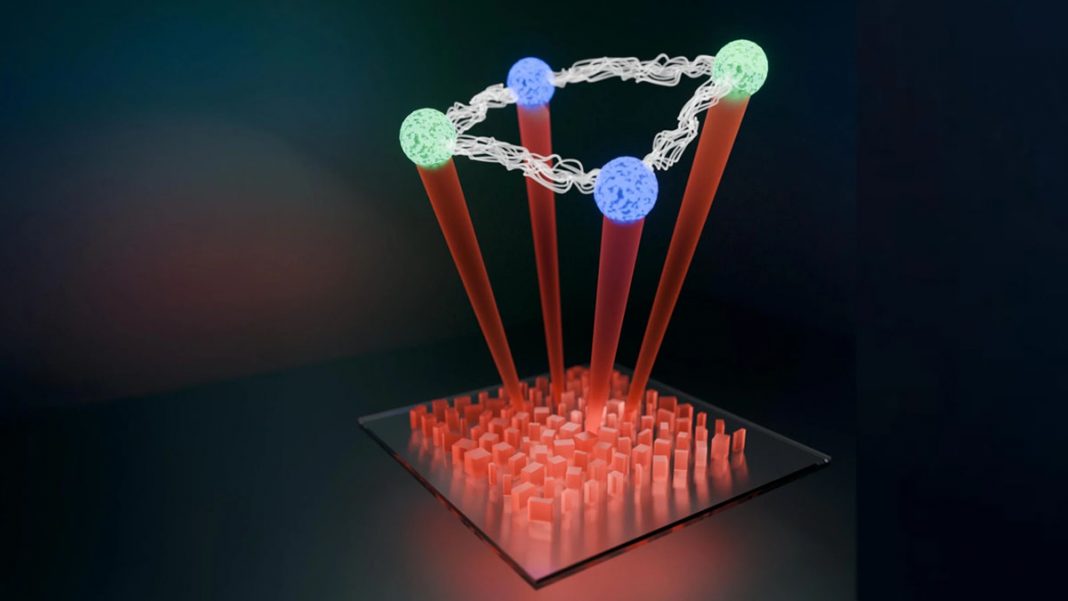
A team led by Prof. Federico Capasso and Dr. Vinton Hayes at Harvard’s John A. Paulson School of Engineering and Applied Sciences has engineered a metasurface that performs the same quantum operations as conventional optical setups—only at a fraction of the size. This metasurface, peppered with nano-scale holes, precisely manipulates light’s brightness, phase, and polarization to control quantum states effectively.
What Makes It Revolutionary
This innovation eliminates the need for complicated quantum optical circuits. Instead, the metasurface chip produces entangled photon states and supports parallel quantum operations—on a durable, compact, and easy-to-fabricate platform. Not only does this reduce optical loss, but it also enhances system stability and makes the technology more accessible for broader quantum applications.
Mathematics Behind the Magic
Scaling these operations is no small feat. As more photons—and thus more qubits—enter the system, the complexity of interference patterns explodes. To tame this, researchers employed graph theory, a mathematical approach that visualizes photon entanglement and interaction paths. By mapping photon behaviors through nodes and lines, the team could predict and optimize experimental outcomes, simplifying what was once a chaotic quantum maze.
A Collaboration-Driven Innovation
The project was a joint effort with Marco Lončar’s quantum optics lab, which brought critical expertise in integrated photonics and experimental validation. Their collaboration ensured that this theoretical breakthrough translated into real-world, lab-tested quantum hardware. This sets the stage for quantum devices that are more compact, cost-efficient, and scalable than ever before.
Why This Matters
Traditional quantum computers based on waveguides or superconductors have struggled with scalability and stability. This metasurface-based approach circumvents those barriers. It opens the door to modular, scalable quantum systems and paves the way for quantum networks and compact processors that could operate with far fewer resources.
Conclusion
This research signifies a powerful step forward in quantum photonic technology. By replacing large optical systems with a flat, resilient metasurface, Harvard’s team is redefining what quantum hardware can look like. Their work could lead to next-generation quantum computers and networks that are smaller, faster, and ready for mainstream adoption.