


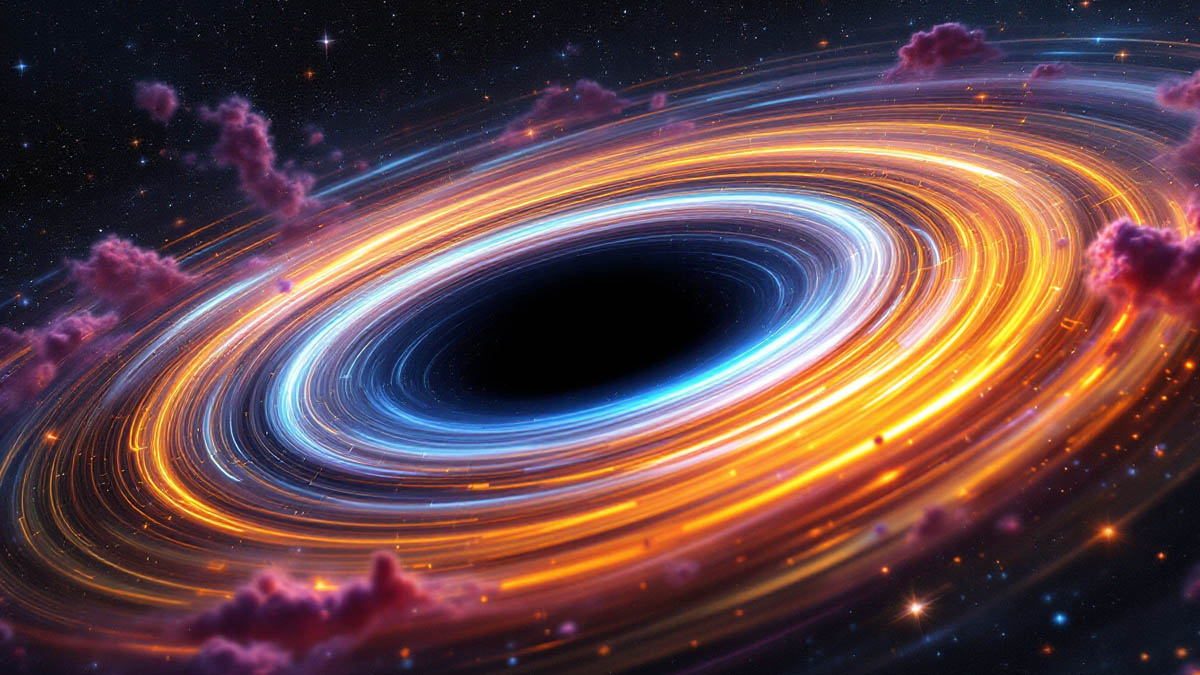
Astronomers have just dropped a cosmic bombshell — the supermassive black holes that once dominated theories of the early universe may not be as massive as we thought. A groundbreaking study conducted by the GRAVITY+ collaboration, including scientists from the University of Southampton, reveals that these enormous entities could be up to ten times smaller than earlier estimations suggested.
Using the ultra-precise GRAVITY+ instrument at the European Southern Observatory’s Very Large Telescope (VLT) in Chile, researchers peered into the core of an infant galaxy located 12 billion light-years away. What they discovered challenges decades of astronomical assumptions about how black holes formed and evolved after the Big Bang.
The team observed an ancient quasar — a bright, active galaxy with a supermassive black hole at its center — and discovered that its black hole weighs roughly 800 million times the mass of the Sun. While that might sound enormous, it’s far less than previously believed for such an early cosmic epoch. This new finding suggests that the methods scientists used to “weigh” early black holes may have systematically overestimated their true mass.
Professor Seb Hoenig from the University of Southampton, a co-investigator and co-lead of GRAVITY+’s Extragalactic Science Working Group, described the results as “a revelation of cosmic proportions.” He explained that scientists have long struggled to understand how supermassive black holes could grow so massive in such a short time after the universe’s birth. “They simply shouldn’t have had the time,” he said. “Our results suggest that previous measuring techniques might not have been reliable in the early universe — and that could force a re-evaluation of our models of cosmic evolution.”
Lead author Dr. Ric Davies from the Max Planck Institute for Extraterrestrial Physics emphasized that this study stands out because it relies on direct observations of gas motion rather than inferred scaling laws. “Our result is reliable because it’s based on the actual motion of the gas,” he said. “If our findings are typical, it means black hole masses in the early Universe have been systematically overestimated.”
The GRAVITY+ instrument achieved its remarkable precision by combining the light from four of the world’s largest optical telescopes, effectively turning them into one massive, synchronized observatory. This technique allowed scientists to track the spiraling motion of hot gas swirling into the black hole’s grasp — a motion critical to accurately determining its mass.
Another astonishing revelation was that the black hole appears to be consuming gas at a rate far faster than previously thought possible, ejecting much of it back into space in a massive outflow. Professor Hoenig likened this phenomenon to “a cosmic hairdryer set to maximum power”, where the intense radiation from the accretion disk blows away incoming gas instead of absorbing it.
The research, soon to be published in Astronomy & Astrophysics, could mark a turning point in how scientists understand galaxy and black hole formation. If further studies confirm these results, the early universe may have contained smaller, more numerous black holes than expected — a revelation that could rewrite the cosmic origin story as we know it.
Conclusion:
This discovery reshapes our understanding of the early universe and challenges long-held theories about the formation of supermassive black holes. By refining measurement techniques and leveraging powerful new tools like GRAVITY+, scientists are uncovering a more accurate — and perhaps even more fascinating — picture of how the universe evolved from its earliest moments.