


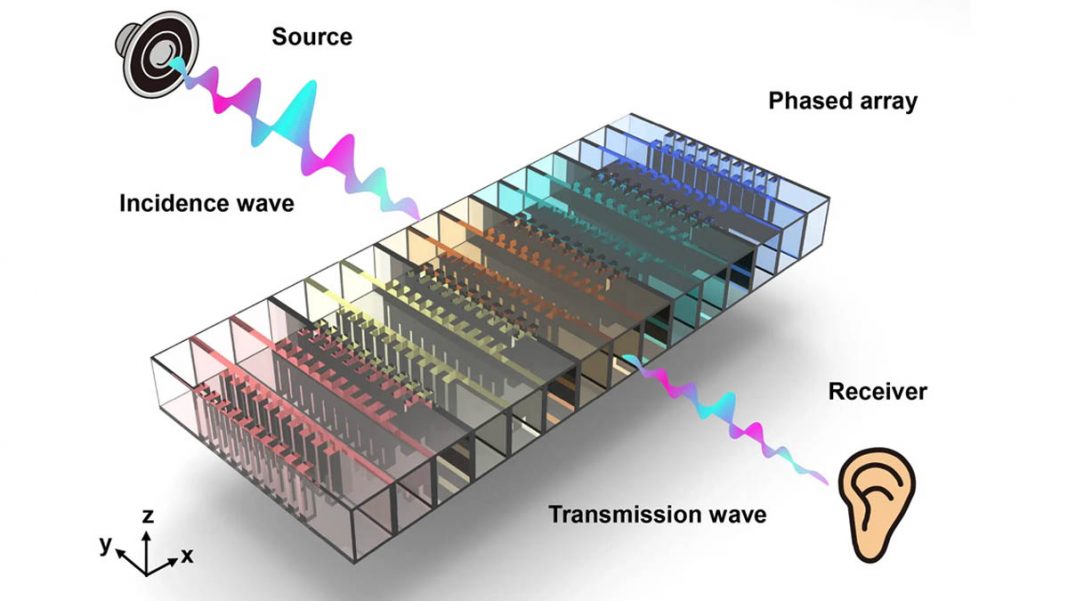
American researchers from Boston University’s Zhang Lab have unveiled a revolutionary metamaterial capable of silencing a wide range of unwanted sounds while allowing unrestricted airflow. This innovation could redefine noise control in offices, public spaces, and transportation hubs.
A Smarter Approach to Noise Suppression
Led by Professor Xin Zhang, the research team developed the Phase-Gradient Ultra-Open Metamaterial (PGUOM). Unlike traditional barriers that block both sound and air, this advanced structure reduces noise without compromising ventilation. Zhang compares PGUOM to noise-cancelling headphones — it adapts to fluctuating sound levels and frequencies, making it highly practical for unpredictable acoustic environments.
“PGUOM maintains high efficiency even as pitch and volume change, making it ideal for dynamic conditions like open-plan offices or busy transit areas,” says Zhang.
How It Works
PGUOM is composed of supercells, each containing three subwavelength unit cells. The first and third cells feature solid barriers that create controlled phase shifts in incoming sound waves. The central cell remains open, ensuring continuous airflow.
This arrangement generates a complete 2π phase gradient in each supercell, transforming incoming noise into surface acoustic waves that dissipate along the material. The result is effective broadband noise suppression without sacrificing ventilation or adaptability.
Customizable and Versatile Design
The design allows for tuning both the frequency range and airflow capacity depending on application needs. Unlike conventional structures, PGUOM’s enlarged central cell offers better adaptability to varying airflow demands while maintaining noise-reduction performance.
Zhang emphasizes the health benefits: long-term exposure to excessive noise can lead to hearing loss, sleep disturbances, elevated stress levels, and even cardiovascular issues. Additionally, noise pollution disrupts wildlife behavior and destabilizes ecosystems.
From Concept to Real-World Applications
The team has already moved from simulations to working prototypes. Their goal is to integrate PGUOM into commercial products while optimizing it for mass production. Future improvements aim for even higher noise attenuation across a broader frequency range, with minimal airflow resistance and reduced material thickness.
Conclusion
This groundbreaking soundproofing technology represents a major step forward in sustainable acoustic management. By combining high efficiency, open airflow, and broad-spectrum noise reduction, PGUOM could soon become a standard in architecture, transportation, and environmental protection.