



A Major Leap in AI Planning: The Rise of Monte Carlo Tree Diffusion
A cutting-edge advancement in artificial intelligence is shaking up how machines reason and plan. A team of researchers has introduced Monte Carlo Tree Diffusion (MCTD) — a novel method that significantly enhances the reasoning efficiency of diffusion models. These models, already widely used in various AI applications, have long lacked effective solutions for inference-time scalability — a critical factor for real-world planning and decision-making.
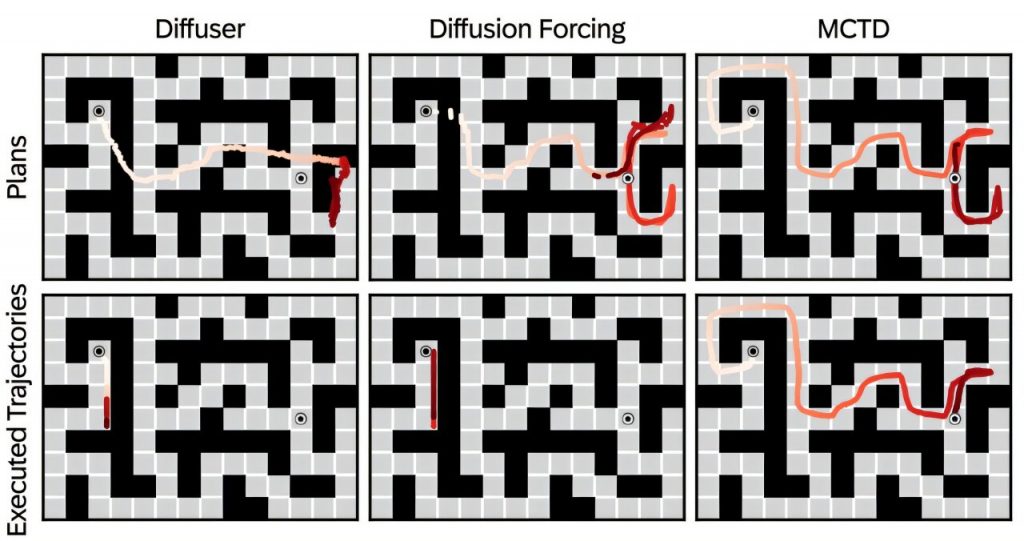
Cracking the Maze: 100% Success Where Others Failed
What makes this breakthrough especially exciting is that the new model achieved a 100% success rate in a giant maze-solving task — an area where all previous approaches failed completely. Existing models like Diffuser and Diffusion Forcing struggled to produce viable trajectories, whereas MCTD succeeded by refining its plans in real time using a tree-based search method.
The ability to reason adaptively and efficiently under constrained computational resources makes MCTD a game-changer for applications such as intelligent robotics, real-time strategy systems, and generative AI.
How It Works: Smarter Inference, Not Just Bigger Models
Instead of simply scaling data or model parameters, this new method focuses on efficient exploration of output space during inference. The secret lies in combining diffusion processes with Monte Carlo Tree Search (MCTS), a technique that enables AI to explore multiple solution paths in parallel.
This innovative framework was developed by Professor Sungjin Ahn from the School of Computing at KAIST, in collaboration with Professor Yoshua Bengio, a leading expert in deep learning from the University of Montreal. The research emerged from a joint initiative between KAIST and Mila (Quebec AI Institute) under the Prefrontal AI Joint Research Center.
Speeding Up for Real-World Use
While the initial success came with high computational demands, the follow-up study — also published on arXiv — tackled this challenge head-on. By optimizing the algorithm for parallel processing, the team accelerated performance by up to 100 times without sacrificing quality. This massive speed gain positions MCTD as a practical solution for real-time applications.
Why It Matters
This breakthrough redefines what’s possible for AI-based reasoning and planning. The ability to efficiently plan, adapt, and make decisions in real time — all without massive computational costs — paves the way for smarter robotics, more intuitive AI assistants, and even real-time simulations in complex environments like traffic systems, logistics, and disaster response.
As Professor Ahn puts it, “This technology fundamentally overcomes the limitations of existing planning methods. It opens the door to core innovations across multiple fields, from robotics to generative systems that rely on real-time decision-making.”