

The Earliest Glimpse Into Planet Formation Ever Recorded
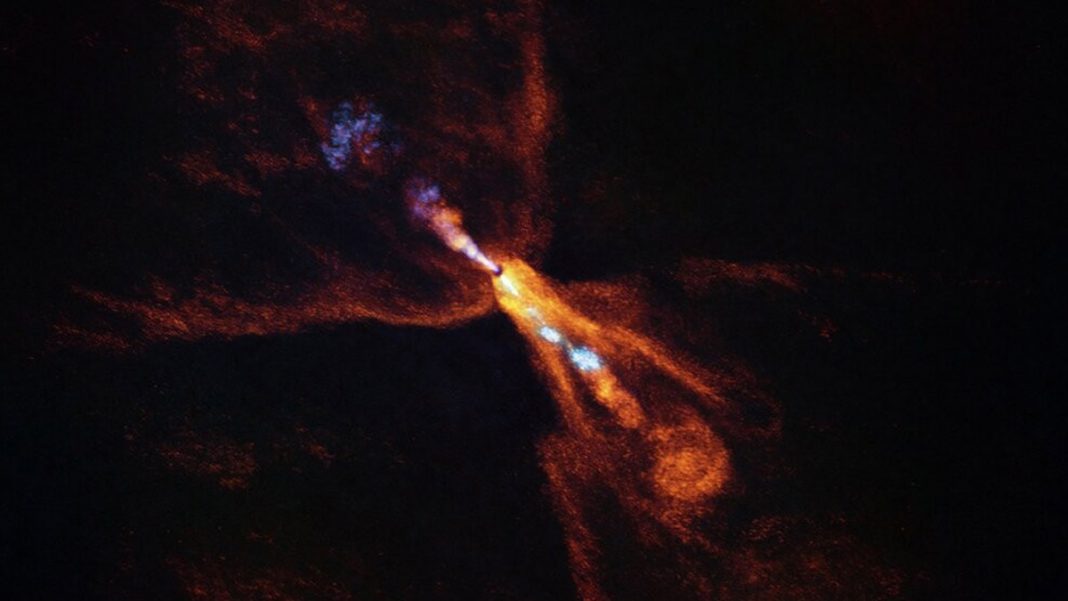
For the first time in human history, astronomers have observed the very beginning of planet formation around a star other than our Sun. Using a combination of the James Webb Space Telescope and ALMA (Atacama Large Millimeter/submillimeter Array), an international team of scientists has detected the first clumps of planet-forming material — hot minerals that are just beginning to solidify. This extraordinary discovery offers an unprecedented peek into what our own Solar System may have looked like in its infancy.
A Snapshot of a New Solar System
The observed event is unfolding around HOPS-315, a protostar located approximately 1,300 light-years away from Earth. Surrounded by a swirling protoplanetary disk of gas and dust, HOPS-315 exhibits the earliest signs of planetary genesis — an occurrence never before directly witnessed.
Lead researcher Melissa McClure of Leiden University in the Netherlands emphasized the uniqueness of this breakthrough, noting: “We’ve identified the very first moment of planet formation around another star.” Her colleague Merel van ’t Hoff from Purdue University likened the moment to viewing a “baby picture of our Solar System.”
Hot Minerals Spark the Process
The formation begins with high-temperature minerals, specifically silicon monoxide (SiO), which condense out of the gas surrounding the star and begin forming crystalline solids. These particles eventually coalesce to create planetesimals — kilometer-sized precursors to full-fledged planets like Earth and Jupiter. The study found clear signs of SiO both in gas form and as solidifying minerals, indicating that the transformation from gas to solid has just begun.
Such early-stage mineral formation has been previously theorized based on the makeup of ancient meteorites found in our Solar System, but never actually observed — until now.
Why This Discovery Matters
Not only does this finding confirm long-held theories about how planets are born, it also sets the stage for future exploration into the conditions required for planet formation. By identifying HOPS-315 as a planetary system in its earliest developmental phase, astronomers now have a valuable reference point for studying the evolution of young stars and their surrounding environments.
The Power of Next-Gen Telescopes
This discovery showcases the combined power of JWST and ALMA, with each telescope bringing complementary capabilities to detect the faintest signals of elemental and mineral activity deep in space.
Professor Edwin Bergin of the University of Michigan emphasized that this is the first-ever observation of such a process outside of our own Solar System, confirming the formation of solid materials that could eventually become new worlds.
Conclusion: A Cosmic Milestone
This discovery marks a new chapter in astronomy, proving that we can not only study mature planetary systems but now also observe the very first sparks of their creation. It provides valuable clues about how Earth and its neighbors may have originated, and strengthens the synergy between next-gen telescopes and human curiosity.
The journey to understanding our cosmic origins just took a monumental leap forward.