


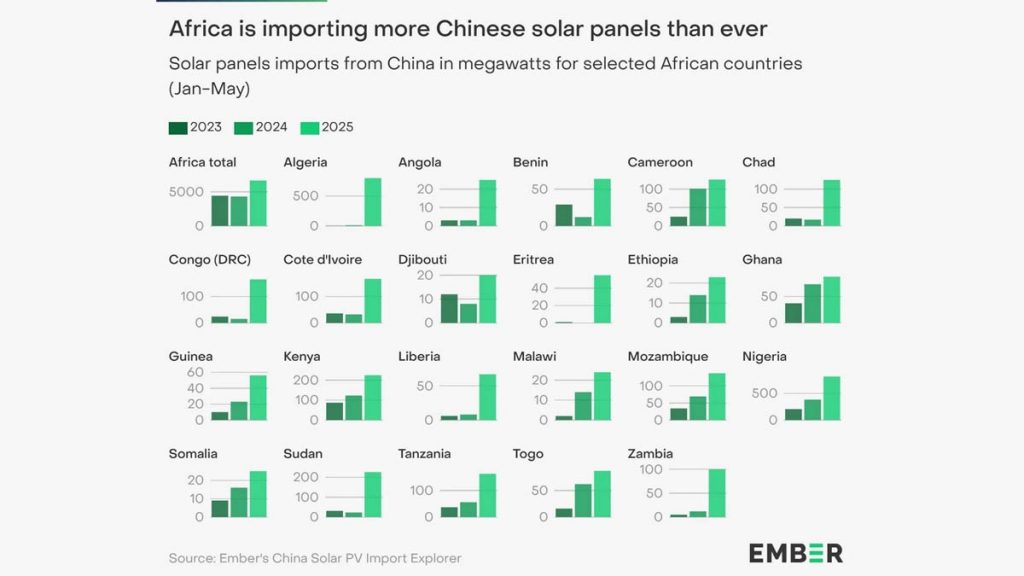
Africa is experiencing an unprecedented surge in solar adoption, driven largely by record imports of Chinese-manufactured solar panels. According to recent data, in May 2025 alone, African countries imported 1.57 gigawatts (GW) of solar panels from China, marking the highest monthly figure in history. This signals a decisive shift in the continent’s energy strategy as governments, businesses, and rural communities look to diversify away from fossil fuels and expand access to electricity.
From January to May 2025, at least 22 African nations imported more solar panels than during the same period in 2024. Many doubled their imports, highlighting both the growing affordability of solar technologies and a strong commitment to renewable energy solutions. Algeria stood out by importing 0.76 GW worth of panels in just the first half of the year, an astonishing 6,300% increase compared to 2024. Meanwhile, smaller economies like Chad acquired enough panels to replace their existing energy generation capacity entirely, signaling a potential leapfrog in energy access.
This boom is tied closely to China’s dominance in the global solar supply chain. The International Energy Agency (IEA) reports that over 80% of solar panels worldwide are produced in China, thanks to large-scale subsidies, mass production efficiencies, and rapid technological improvements. Historically, China exported the bulk of its solar panels to Europe, North America, and Asia, but Africa’s growing appetite suggests the continent is becoming a significant emerging market.
The implications are vast. In South Africa, favorable government policies—such as tax incentives for solar purchases and compensation schemes for feeding excess energy back into the grid—have accelerated adoption. Similar strategies are now being considered by North African countries like Egypt and Algeria, where industrial-scale solar power plants are under construction. Meanwhile, in sub-Saharan Africa, off-grid rural communities are increasingly turning to solar solutions as their first-ever access to reliable electricity.
Yet challenges remain. Some African governments, including Nigeria, have attempted to regulate imports, at one point banning Chinese solar panels before quickly reversing the decision. Additionally, while solar demand is surging, local manufacturing capacity remains extremely limited. Policymakers across the continent are now debating whether to introduce incentives for domestic assembly and small-scale production of solar panels, which could reduce dependence on imports and create local jobs.
Conclusion: Africa’s record-breaking import of Chinese solar panels reflects both a rapid energy transition and the continent’s growing role in the global solar market. While imports are fueling immediate growth, the next strategic step for African nations may be to develop domestic solar industries that balance affordability, energy independence, and long-term sustainability.