


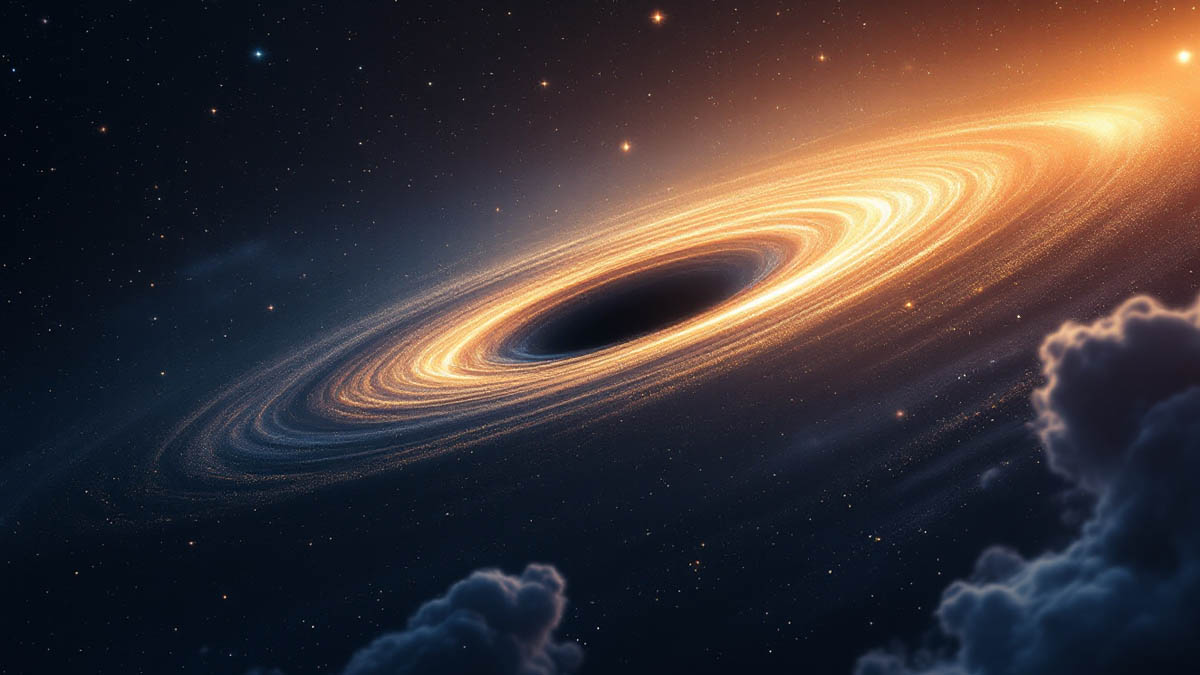
Astronomers have discovered a mysterious cosmic object glowing faintly in the distant depths of space — and it could rewrite the foundations of cosmology. Detected by NASA’s James Webb Space Telescope (JWST), this object may be a primordial black hole — one that existed before the first stars were born. If confirmed, the finding would fundamentally challenge our current understanding of how the Universe evolved after the Big Bang.
After the Big Bang, the Universe was filled with turbulent plasma — too hot and chaotic for any structure to form. It took hundreds of thousands of years before simple hydrogen atoms could exist and another hundred million years before massive hydrogen clouds condensed into the first stars. Cosmologists have long believed that black holes formed later, as collapsing remnants of those early stars. However, new evidence suggests the reverse may be true — that black holes came first, serving as seeds for galaxy formation.
The newly detected object sits far beyond the most ancient galaxies ever observed, radiating in a way that suggests it might not be a star or a cluster, but a massive black hole from the dawn of time. Researchers analyzing the Webb data published their findings this month, hinting that this entity could be a direct remnant of the early Universe’s inflation phase — when quantum fluctuations may have triggered collapses forming “primordial” black holes before any stars existed.
For centuries, black holes were merely theoretical constructs. In 1783, John Michell speculated about “dark stars,” bodies so dense that not even light could escape their gravity. It wasn’t until the 20th century that scientists like Karl Schwarzschild and Robert Oppenheimer gave these ideas mathematical form, using Einstein’s theory of relativity. Still, it took until 1972 for astronomers to confirm the existence of an actual black hole. Since then, we’ve found them scattered throughout the cosmos — from stellar black holes a few times the Sun’s mass to supermassive ones anchoring galaxies like the Milky Way.
Most known black holes arise from the collapse of dying stars. But theoretical physicists, including Stephen Hawking, have long proposed that some might have formed much earlier. During the Universe’s rapid expansion, quantum fluctuations could have created localized regions of extreme density, collapsing under their own gravity — forming black holes billions of years before stars existed. If the Webb object is indeed such a black hole, cosmologists will need to revisit core models of cosmic evolution.
Observing this entity is itself a technological miracle. Located at the edge of the observable Universe, it emits almost no light, making it nearly invisible. Astronomers infer its presence from the faint interaction between surrounding hydrogen and helium — the primordial gases left over from the Big Bang. Unlike typical black holes, which blaze brightly as they consume nearby matter, this one seems “naked” — a silent relic of the cosmic dawn.
Of course, not all scientists agree on the interpretation. Some suggest it might be a massive gas cloud collapsing directly into a black hole, bypassing the star stage altogether. Others argue it could be a completely unknown type of cosmic structure. Regardless, the discovery underscores how the James Webb Telescope is revolutionizing astronomy, allowing us to glimpse phenomena once thought beyond reach.
If confirmed as a primordial black hole, this finding would shift the timeline of cosmic creation and suggest that black holes played a role in shaping the early Universe, not just consuming it. Even if later disproven, it reminds us how much of the cosmos remains uncharted — and how every new discovery brings us closer to understanding our place in an ancient, evolving Universe.